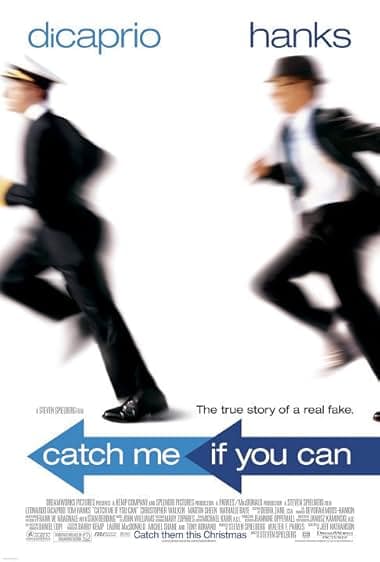
Catch Me If You Can
A breezy con, a missing home and two men who need each other more than they admit.
Feature presentation
Catch Me If You Can keeps turning up in conversations because it’s built around a character who is impossible to ignore: a teenage impostor who treats reinvention like a survival skill. Steven Spielberg stages that flight with a wink and an easy energy, so the movie feels less like a true-crime dossier and more like a long, bittersweet game. Rewatch it and you realise the caper is only the surface; the real engine is why Frank keeps running.
THE MOVIE
Frank Abagnale Jr. is still the reason this movie works
People still talk about Catch Me If You Can because it gives us a con artist who is both a showman and a hurt kid. The movie follows Frank Abagnale Jr., a teenager in the early 1960s who keeps remaking himself as pilots, doctors and lawyers while staying several steps ahead of the authorities.
That constant shape-shifting reads as bravado, but Spielberg ties it straight back to family: a messy, public collapse at home — his parents’ split — is treated as the thing that sends Frank out into the world looking for approval and a place to belong.
So the film’s pleasures are twofold: the surface dazzle of scams and impersonations, and a quieter tug about identity. It’s a handsome, long-running piece of filmmaking (141 minutes) but it never forgets the small psychology that makes the tricks matter.
THE SETUP
The idea that sets Catch Me If You Can in motion
You can describe the plot in a sentence: a teenage fraudster assumes impressive identities and moves through dozens of near-misses with the law. But that doesn’t quite capture why the premise works on screen.
Structurally the film is a series of identity switches: Frank uses charm and paperwork as his tradecraft, each new persona a neat social-engineering problem to be solved. The pleasures are episodic — you get a new disguise, a new small con, a narrow escape.
Crucially the movie pairs those caper episodes with an extended pursuit. The cat-and-mouse pattern gives each scam context: it’s not just a trick, it’s something that rewrites how Frank and his pursuer recognise one another over time.
Spielberg’s marketing never pretends this is a literal documentary; the film presents itself as dramatized and explicitly trades on being ‘inspired by a true story,’ which lets it lean into charm without getting bogged down in forensic realism.
THE CHARACTER
Why Frank Abagnale Jr. matters
Frank isn’t memorable because he’s endlessly clever — although he is — but because the film keeps nudging you to see what the cleverness is covering. He’s a resourceful, attention-seeking teenager, the sort who can make an airplane uniform and a fake cheque look like social currency.
Those scams are framed as more than greed. After his family collapses, Frank’s impersonations look like quests for status and belonging: each new role is a rehearsal for a life where he might finally be accepted.
The film also sets up an emotional genealogy: his father is shown as an ambitious, pride-driven man whose own failures echo in Frank’s need for validation. It’s easy to enjoy the tricks, but the family thread keeps bringing the movie back to something human-sized.
And because Spielberg and the screenplay treat the chase as more than procedural, Frank’s story becomes about recognition — who sees him as a criminal and who sees what he’s actually trying to be.
THE PERFORMANCE
Why Leonardo DiCaprio's performance matters
Contemporary critics homed in on DiCaprio’s turn for a reason: his Frank reads as breezy and disarming, the sort of presence that makes scams feel like small theatrical moments rather than mere criminality.
That quality matters because the film’s moral ambiguity depends on it. If Frank were only a menace, the movie would be one thing; played as an appealing, nimble teenager, his choices invite audience complicity.
DiCaprio’s portrayal keeps the film light enough to enjoy as a caper while still allowing the loneliness beneath to show through between the tricks.
So his performance is the hinge: it’s the reason the movie can be funny and sympathetic, and also quietly uneasy.
UNDER THE SURFACE
Catch Me If You Can has more on its mind than the plot suggests
On the surface it's a caper about cons; under the surface it's a film about constructed selves. Identity and performance are constant: the movie asks how convincingly a person can live a role before that role becomes them.
That ties directly into deception versus talent. Frank’s scams are partly about technique — charm, paperwork, timing — but the film repeatedly flirt with the idea that there’s a real ability behind the lies, which complicates our judgment of him.
There’s also a cat-and-mouse obsession running through the story: the pursuer and pursued shape one another. Over time the FBI agent becomes less a faceless lawman and more a mirror to Frank’s own professional identity.
Finally, loneliness and family are the emotional undercurrent. The tricks are spectacle; the film’s quieter scenes insist the conman’s restlessness is a form of searching for connection he hasn’t managed at home.
THE FILMMAKING
How Catch Me If You Can was put together
Spielberg surrounded the story with careful period detail. The production design and location work aim to recreate an early-1960s world — airports, offices and hotel lobbies — and that attention won industry recognition.
On a crew level the film assembled an experienced team: Janusz Kamiński was the cinematographer, Michael Kahn edited, and Jeannine Oppewall handled production design — names that signal a classical, polished studio craft.
That polished production matters because it gives the cons a believable stage. The movie isn’t flashy with effects; it builds its credibility from sets and locations that sell the era and the small deceptions contained within it.
So the filmmaking supports the tone: it’s neat, purposeful and geared to letting character beats breathe while maintaining a pleasing period ambience.
PRACTICAL EFFECTS
The effects work that gives Catch Me If You Can its physical personality
The film leans on tangible production craft rather than digital spectacle. Sets, costumes and repurposed locations — including airport terminals and city streets dressed as 1960s spaces — are the visible backbone of its world-building.
That hands-on approach was more than cosmetic: the art department and set decoration were singled out for capturing interiors and public spaces in a way that felt historically convincing, and that work received industry recognition.
Because the movie’s drama often depends on small, believable details — a lobby, a ledger, a boarding pass — the practical build becomes part of the storytelling muscle.
In short: the period feel is earned by real sets and decoration, not flashy optical trickery.
PURE 00s
Catch Me If You Can could not belong to any other decade
Released at the end of 2002, Catch Me If You Can sits among a batch of early-2000s studio films that mined ‘inspired by a true story’ memoirs for mainstream audiences. That framing shaped how the movie was sold: dramatic but not investigative.
The film’s choice of a jazz-tinged score and meticulous retro production design fits a particular early-2000s taste for period pastiche — films that used music and production values to conjure a mid-century atmosphere for modern viewers.
That blend of affectionate pastiche and dramatic licence feels very of its time: mainstream, confident, and oriented around star power and polished craft rather than gritty realism.
Which is to say: it’s a 2000s studio picture in style and strategy, not because of laconic nostalgia but because of how it combined marketing, music and production design into a package that invited audiences in.
WATCHING IT NOW
What has aged — and what hasn't
The movie’s central emotional threads hold up. Its interest in loneliness and family keeps the spectacle tethered to something human; those beats still land because the narrative continually returns to them.
Stylistically, the film’s polished tone and period trimmings may read as deliberate pastiche today, but that’s part of its charm rather than a liability: the retro score and design still provide a pleasurable backdrop to the character work.
Where it might feel less urgent is in the implied moral complexity. Because the film prefers a light touch, modern viewers who want harder questions about the ethics of glorifying a conman may find it slipperier than they’d like.
But if you come for craftsmanship and the human currents beneath the scams, Catch Me If You Can still has a lot to offer.
THE LEGACY
Why Catch Me If You Can still matters
Part of the film’s afterlife rests on its craft recognitions: Christopher Walken’s supporting turn earned major industry awards attention and an Academy Award nomination, and John Williams’ score also received an Oscar nod.
Production design was similarly noticed — the film’s recreation of the early 1960s picked up recognition from art directors’ organisations and helped sell the movie’s period look.
Beyond trophies, Catch Me If You Can keeps appearing in conversations about early-2000s studio biographies and in retrospectives of Spielberg’s work after the 1990s; it’s cited as an example of his lighter, character-driven caper mode.
Those acknowledgements matter because they underline what the film does best: it’s a polished, well-crafted piece of entertainment that also gives its characters room to feel complicated.
THE VERDICT
Does Catch Me If You Can still hold up?
Yes — mainly because the movie knows what it wants to be. It’s a long, entertaining run through a young conman’s career of impersonations, but at every turn the film ties those games back to personal stakes: family breakdown and a teenage search for belonging.
The central relationship — the transatlantic, episodic chase between Frank and the FBI agent Carl Hanratty — gives the piece its rhythm. Those alternating near-captures and growing mutual recognition keep the film lively and emotionally interesting.
If you’re worried it glamorises deceit, remember the film positions itself as dramatized and ‘inspired by’ a memoir; Spielberg opts for a tone that privileges character and craft over forensic condemnation. That choice won’t satisfy everyone, but it’s consistent and, for many viewers, rewarding.
So if you’re deciding whether to watch it now: go for the combination of smart plotting, the human questions beneath the scams, and the period polish. It’s a compelling portrait of a young man who can make himself anyone — and still can’t quite find his way home.
Share this movie
Keep watching
More movies from the 00s

2002
The Pianist
A quiet life unmade by war — and a pianist who refuses to stop listening.
Read the retrospective
→
2006
Blood Diamond
A mercenary, a fisherman and a pink diamond — and a film that still asks who pays for our jewellery.
Read the retrospective
→
2003
Kill Bill: Volume 1
A yellow jumpsuit, a long list of enemies and one woman who refuses to be finished.
Read the retrospective
→