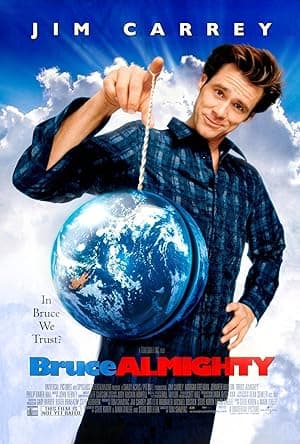
Bruce Almighty
A man, a channel-three newsroom and the world's most awkward probationary godhood.
Feature presentation
Bruce Almighty still hooks people because it pairs a very human grump with an absurdly big premise: a frustrated Buffalo TV reporter gets handed divine authority and discovers that fixing everything is harder than it looks. Tom Shadyac keeps the tone broad and warm, and the film owes a lot of its momentum to Bruce Nolan's particular brand of impatience.
THE MOVIE
Bruce Nolan is still the reason this movie works
Bruce Nolan is the kind of local TV reporter who can charm a small town and simmer with professional frustration at the same time. He’s being shoved into human-interest pieces while wanting bigger stories — which sets up the film’s mischief and its grievance.
One on-air rant and a run of rotten luck later, he ends up face-to-face with God — in human form — and is handed a chance to run the world for a while. The set-up is gloriously simple: give a combustible man omnipotence and watch him try to fix what he thinks is broken.
That’s where the movie’s nervous energy comes from. It isn’t only a series of miracles and sight gags; it’s a sketch about responsibility. The comedy lives in Bruce’s impatience and entitlement, and Bruce Almighty keeps nudging him — and us — toward the idea that power needs ethical muscle, not just clever tricks.
THE SETUP
The idea that sets Bruce Almighty in motion
The engine of the story is straightforward: Bruce rails at God and, to his surprise, receives the chance to 'try the job' himself. That neat fantasy hook turns a familiar midlife/ambition gripe into a literal experiment in omnipotence.
Once Bruce has power, the film uses a handful of repeat mechanics: physical miracles, selective responses to prayer and a steady parade of consequences that ripple out from what seem like small changes. Those devices keep the comedy lively while also showing that easy fixes have costs.
The stakes are not cosmic theology so much as everyday consequences. Bruce’s struggle becomes less about proving God wrong and more about figuring out how to wield authority without wrecking lives or relationships.
It’s a premise that allows the film to swing between big set pieces and intimate moments, always returning to the central question: what happens when someone who wants recognition is suddenly given the means to get it?
THE CHARACTER
Why Bruce Nolan matters
Bruce Nolan matters because he’s not a saint waiting for tests; he’s a hungry, career-driven guy who thinks more recognition will fix everything. That ambition — the resentment about being stuck on small stories — is the motor behind almost every choice he makes once he gains power.
The film stages that ambition against people who keep him grounded. Grace, his partner, is the practical counterpoint whose steadiness gets tested by Bruce’s behaviour; their relationship is where the abstract experiment of omnipotence becomes personal.
There’s also a newsroom rivalry baked into Bruce’s arc. An early public humiliation of Bruce’s rival becomes one of the first times he uses his new abilities, and those moments kick off the unintended consequences that drive the plot.
Put simply: without Bruce’s particular mix of impatience and wounded ambition, the movie would be a series of miracles. With him, it’s a lesson about character and choices — not just spectacle.
THE PERFORMANCE
Why Jennifer Aniston's performance matters
Contemporary reviewers singled out the role of Grace as an important stabiliser for the film’s more extravagant moments. That matters because the movie keeps returning to their relationship as the test of Bruce’s growth.
Grace functions as the emotional yardstick; when Bruce starts to use God’s powers selfishly, the strain in their relationship shows the cost of his choices in everyday terms.
That anchoring gives the film something to come back to whenever the set pieces risk tipping into pure spectacle. It turns Bruce’s big mistakes into recognisable human problems.
In short, the supporting turn in the role helps stop Bruce Almighty from floating off into inconsistency: it makes the consequences feel real.
UNDER THE SURFACE
Bruce Almighty has more on its mind than the plot suggests
At face value it’s a gag-driven comedy about miracles. Underneath, it’s asking what responsibility looks like when power has no obvious limits. That question anchors the laughs with consequences.
The film also plays with free will versus intervention. Bruce’s temperament tempts him to tidy other people’s lives, and the movie shows how well-intentioned interference can remove agency and create mess instead of meaning.
Faith and gratitude thread through the story without pinning the film to a single religious argument. It’s less about doctrine and more about how gratitude — or the lack of it — shapes human relationships.
Finally, the story sits comfortably in a newsroom/celebrity world, so media ambition and the hunger for recognition are part of the moral problem. Bruce’s wish for fame is not just vanity; it’s what leads him to try rewriting other people’s outcomes.
THE FILMMAKING
How Bruce Almighty was put together
On the practical side, Bruce Almighty is built as a crowd-pleasing studio comedy. The credits point to experienced hands shaping its look and pace, with a named director of photography and an established production designer on board.
Critics noted that the film aims to suggest Buffalo while leaning on studio settings and backlot work. That pragmatic approach keeps the focus on the performances and the fantasy conceit rather than on location authenticity.
Those choices help the movie feel like a comfortable, slightly glossy mainstream comedy — the kind that wants to be widely accessible while still leaving room for big visual jokes.
In short: the filmmaking keeps the world tidy and serviceable so the moral experiment and character beats can take centre stage.
PRACTICAL EFFECTS
The effects work that gives Bruce Almighty its physical personality
When the movie needs the fantastical to happen, it leans on bluescreen compositing and VFX work to sell the miracles. That approach lets the filmmakers stage obvious supernatural moments without pretending they’re practical tricks.
Industry listings and reviews credit several visual-effects vendors with the film's effects work, which is to say the miracles are a deliberate studio collaboration rather than a lone craftsman’s flourishes.
Using compositing gives the movie the freedom to stage large, clean set pieces that read well to family audiences and support the comedy rather than distract from it.
So the effects are functional: they exist to make the premise readable and to carry the gag mechanics, rather than to call attention to themselves as technological showmanship.
PURE 00s
Bruce Almighty could not belong to any other decade
Bruce Almighty wears its era on its sleeve because it’s a star vehicle built around a well-known comedian’s screen persona, married to a high-concept fantasy setup. That mix was very much an early-2000s studio strategy.
The film’s family-friendly PG-13 framing and use of broad studio effects mark it as a mainstream tentpole comedy of its moment: aimed at wide audiences, safe for younger viewers, with room for spectacle.
It also spawned a production-related sequel a few years later that carried the premise forward with one of its supporting characters promoted to lead, which shows how the basic idea was seen as flexible enough to revisit.
Released in 2003, it sits neatly in the pattern of comedies that wanted to be both crowd-pleasing and idea-driven — a popcorn-friendly thought experiment.
WATCHING IT NOW
What has aged — and what hasn't
Views since release have split on the film’s tone: some of its mix of big-gag comedy and earnest sentimental messaging reads as very of-its-time, while others find that combination exactly what they remember enjoying about early-2000s studio comedies.
The film’s tendency to move from high-concept jokes into a sentimental final act is a stylistic choice that will please viewers who like tidy lessons and frustrate those who prefer ambiguity.
Technically and tonally, it feels like a mainstream picture from its period — which will feel comforting to some and slightly dated to others, depending on taste.
Also: the story proved durable enough for a later spinoff that shifted focus to a supporting character, showing the premise wasn’t tied exclusively to its original lead.
THE LEGACY
Why Bruce Almighty still matters
One concrete measure of the film’s afterlife is that its central idea was used again: a spin-off switched the focus to a secondary character while keeping the personification of God in place.
That continuation suggests the premise had enough narrative wiggle-room to be reworked, even if the later film didn’t bring back the original romantic pairing or lead.
Beyond that, its lasting presence in conversations about early-2000s comedy comes from how it blends a star vehicle with a simple moral experiment — an approach other studio pictures of the era also favoured.
It’s remembered partly because it asks an obvious question in an obvious way and then invites audiences to laugh along while watching a man figure out how to live with what he’s been given.
THE VERDICT
Does Bruce Almighty still hold up?
Yes — but with caveats. If you enjoy a broad comedy that pairs sight gags with a moral tidy-up, Bruce Almighty still delivers. The pleasures are structural: a relatable, frustrated local reporter is given divine power, misuses it for selfish gains, and then has to confront the fallout.
The core dramatic engine — Bruce learning that power carries responsibility and that quick fixes create deeper problems — remains coherent and watchable. The film shows consequences unfolding from small choices, which keeps the stakes intelligible.
Where it may lose modern viewers is in its tonal shifts: the move from high-concept jokes toward a sentimental resolution is very much a stylistic choice of its period. If that kind of neat, lesson-driven ending irritates you, the film will feel dated.
But if you’re curious about a roomy, thoughtful-enough comedy that uses fantasy to test character, Bruce Almighty is still worth a watch. It’s a reminder that handing someone the keys doesn’t mean they know where to drive them.
Share this movie
Keep watching
More movies from the 00s

2002
The Pianist
A quiet life unmade by war — and a pianist who refuses to stop listening.
Read the retrospective
→
2006
Blood Diamond
A mercenary, a fisherman and a pink diamond — and a film that still asks who pays for our jewellery.
Read the retrospective
→
2003
Kill Bill: Volume 1
A yellow jumpsuit, a long list of enemies and one woman who refuses to be finished.
Read the retrospective
→