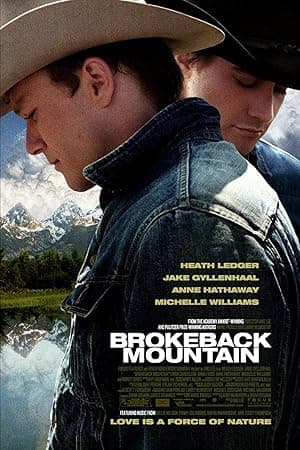
Feature presentation
Brokeback Mountain is one of those films you recognise the moment a single image or name is mentioned: two young men, a summer on a mountain, and a secret that shapes decades. Ang Lee’s film still draws you in because it trusts one stubborn idea — that a single relationship can quietly reroute entire lives — and then watches the consequences unfold.
THE MOVIE
Ennis Del Mar is still the reason this movie works
You remember the mountain before you remember the awards: two ranch hands hired for a summer, a job that should be routine, and a first intimacy that turns into a lifetime’s quiet crisis. That summer on Brokeback Mountain is the inciting moment that the whole film keeps returning to — the memory that both men carry and that reshapes everything that comes after.
What makes the film hang together is not spectacle but a person. Ennis Del Mar — the reserved, emotionally guarded ranch hand at the film’s centre — is written and staged as someone whose childhood exposure to violence and strict masculine codes has taught him to fear intimacy. His fear isn’t a plot device; it governs his choices and turns private desire into a series of small, costly compromises.
Ang Lee directs the film with those limits in mind, tracing the distance between mountain and town, between what is possible in isolation and what is possible under social pressure. Heath Ledger plays Ennis; Jake Gyllenhaal plays Jack. The performances and the framing keep that core question in view: what happens when two men build a bond they cannot safely admit?
THE SETUP
The idea that sets Brokeback Mountain in motion
At its simplest: Ennis Del Mar and Jack Twist meet on a remote mountain, form a sexual and emotional bond during that summer, and then re-enter the wider world where their private relationship collides with the demands of marriage, jobs and community. The tension between those two worlds — the mountain’s freedom versus town life’s constraints — is the engine of the story.
The film doesn’t try to squeeze everything into one neat arc. Instead, it lets the relationship recur across years as clandestine meetings and missed chances, so you feel the cumulative cost of concealment rather than just seeing a single betrayal or reconciliation.
This screen version expands Annie Proulx’s short story in clear ways: the female characters have more space, and the film deliberately shows extended sequences of civilian life — marriages, parenthood, work — so the contrast with the mountain becomes concrete and sometimes painfully ordinary.
That structural choice is why the premise works: the initial summer supplies the spark, but the film is really about how two men attempt, and largely fail, to make that spark survive ordinary life.
THE CHARACTER
Why Ennis Del Mar matters
Ennis is not a flamboyant romantic lead. He’s the opposite: a man who has learned to hold everything in. That learned restraint — shaped by a violent childhood and by strict ideas about what a man should be — makes him the story’s clearest point of tension. His fear of being openly intimate isn’t a quirk; it’s what most of the plot turns on.
The film sets Ennis next to Jack, who is more outward and restless. Jack wants recognition, a future, a way to make their relationship live beyond occasional weekends. That contrast gives the movie its drama: two men who want different things from the same bond, and who cope with social pressure in very different ways.
Giving Ennis so much interior resistance turns many small domestic moments into heavy decisions: whether to move, whether to confess, how to live with the consequences. Those are the choices that make him memorable — not grand speeches or cinematic revelations, but the tiny refusals and accommodations that add up.
Finally, the film’s expansion of the short story — showing the men’s marriages and civilian lives — makes Ennis’s emotional containment visible to us. It’s in the marital compromises and the everyday silences where you see what his restraint actually costs.
THE PERFORMANCE
Why Heath Ledger's performance matters
Contemporary coverage singled out the leads as the emotional core of the film, and the awards season attention backed that up with major acting nominations for Heath Ledger, Jake Gyllenhaal and Michelle Williams. That kind of response tells you the performances were doing the heavy lifting — making interior conflict readable without speechifying.
Within the film’s machinery, Ledger’s Ennis provides the necessary still point: the character’s restraint is the dramatic material, and the contemporary response shows that critics and industry observers recognised how central that stillness was to the picture’s impact.
UNDER THE SURFACE
Brokeback Mountain has more on its mind than the plot suggests
On the surface it’s a romance, but the film persistently asks what forbidden love does to ordinary lives when social repression forces desire underground. The narratives of marriage, parenthood and work are not just background; they’re the pressure the relationship must resist — and mostly cannot.
Closely tied to that is the film’s study of masculinity. Codes of behaviour — how men are taught to act — shape violence, withdrawal and silence in this story. The tragedy here often reads less like a single event and more like a long habit: the habit of not being able to say what you feel.
Memory and regret thread through the episodic structure. Because the film skips across years, we live with the cumulative effect of small decisions rather than a single melodramatic turning point; that slow accrual is where regret becomes heavy and recognisable.
And then there’s the landscape. The mountain sequences are staged as a freer emotional space, a place that suggests possibility in a way the towns rarely do. The contrast between that openness and the enclosed rhythms of domestic life keeps the film’s feelings in visual and narrative tension.
THE FILMMAKING
How Brokeback Mountain was put together
On the technical side, the film’s editors — Geraldine Peroni and Dylan Tichenor — shaped the narrative’s episodic leaps, which is crucial because the story covers roughly two decades. The editing choices determine how memory feels on screen and how much weight a single quiet scene carries between time jumps.
Post-production wrapped in spring 2005, which positioned the film perfectly for the festival and awards run that followed. Those production rhythms matter: this felt like a carefully finished, deliberately paced picture rather than something stitched together in rush.
Ang Lee’s direction trusts that the script and the performances will carry the emotional load, and the editors’ work lets moments breathe instead of forcing them into explanation. The result is a film that looks like a literary adaptation in its appetite for detail and withholding.
PRACTICAL EFFECTS
The effects work that gives Brokeback Mountain its physical personality
Shooting on location in the Alberta plains demanded practical, hands‑on solutions. For example, ambient moonlight scenes relied on bounced light from weather balloons — a straightforward, physically grounded approach to getting natural-looking night exteriors.
The production used real livestock and credited local animal wranglers; that kind of authenticity matters in scenes where people and animals share a frame, because small, lived-in details register as truthful in ways digital substitutes often don’t.
Stunt coordination and rodeo sequences were handled on location with local technical advisors and riders appearing onscreen. Those choices make the film feel lived-in: when the camera watches horses, gates, and barns, the world reads as a functioning rural community rather than a set of props.
PURE 00s
Brokeback Mountain could not belong to any other decade
Released in 2005 and premiering at Venice that September, Brokeback Mountain arrived squarely in awards season and stayed there. That timing helped the film be taken seriously as a mainstream drama during the mid-2000s.
What made it feel particularly of its moment was how it brought an explicitly LGBTQ-themed narrative into sustained national conversation within mainstream cinema. It wasn’t a niche art‑house project; it was a major awards-season title that invited debate about representation and recognition in Hollywood.
Winning the Golden Lion at Venice and then carrying through into the awards season gave the film the institutional platform to be discussed widely. In the mid-00s that combination — festival prestige, awards attention, and a mainstream studio backing — meant a queer story could be argued about in everyday media in ways that had been rarer before.
WATCHING IT NOW
What has aged — and what hasn't
The core relationship still reads because the film makes that relationship its constant reference point: the inciting summer on the mountain remains the emotional anchor for decades of scenes that follow. That structural clarity helps the story survive changes in taste.
The screenplay’s expansion of the short story — giving Alma and Lureen more presence and showing extended civilian-life scenes — also helps a modern viewer understand the social trade-offs the men make. Those added domestic details make the compromises feel concrete and relatable today.
Ang Lee’s move back into intimate literary adaptation after studio-scale projects demonstrates a directness that hasn’t dated: he’s interested in people pushed against social strictures, and that interest translates across time because it’s about human choices, not gimmicks.
So what hasn’t aged? The central conceit — a private love at odds with public life — still plays. The film’s choices about scope and characterisation remain a useful way to show how decades of small decisions can become a kind of tragedy.
THE LEGACY
Why Brokeback Mountain still matters
The film’s festival and awards run is part of its continuing story: winning Venice’s Golden Lion and then receiving multiple Academy Award wins and nominations anchored it in the public conversation of 2005–2006. Those honours meant the film was not just discussed as a movie but argued about as a cultural moment.
The Academy wins — for Best Director, Best Adapted Screenplay and Best Original Score — and the Best Picture debate that followed (it lost to Crash) produced visible public discussion. That debate made the film part of a wider conversation about what kinds of stories Hollywood acknowledges.
Beyond prizes, the film remains a frequent reference point in conversations about how queer narratives entered mainstream American cinema in the 2000s. Its presence in those discussions keeps it relevant: people still look back to it when talking about representation and awards recognition during that decade.
THE VERDICT
Does Brokeback Mountain still hold up?
Yes — but with an important caveat. If you come for the central relationship and the emotional accumulation of years, the film still delivers. The inciting summer on the mountain and the recurring clandestine meetings that follow are dramatized so the cost of concealment becomes a palpable thing rather than an abstract idea.
Where it earns that continued watchability is in the way the narrative uses time. The episodic jumps across roughly twenty years make memory and regret feel inevitable: small decisions pile up until the consequences are unmistakable. That structure rewards patience rather than instant catharsis.
The movie also benefits from choices that make the private public enough to be felt: the screenplay enlarges the wives’ roles and shows the protagonists’ civilian lives, which keeps the stakes anchored in family and community rather than allowing the love story to float in isolation. And Ang Lee’s and the production’s repeated emphasis on Ennis’s restraint — a point often noted in contemporary coverage — underlines why the film’s quieter moments count.
So should you watch it? If you want a romance that insists on the awkward, ordinary arithmetic of forbidden love — the small refusals, the missed chances, the life built around secrecy — then yes. Brokeback Mountain still works because it remembers the cost of what men were taught not to say.
Share this movie
Keep watching
More movies from the 00s
2002
The Pianist
A quiet life unmade by war — and a pianist who refuses to stop listening.
Read the retrospective
→
2006
Blood Diamond
A mercenary, a fisherman and a pink diamond — and a film that still asks who pays for our jewellery.
Read the retrospective
→
2003
Kill Bill: Volume 1
A yellow jumpsuit, a long list of enemies and one woman who refuses to be finished.
Read the retrospective
→