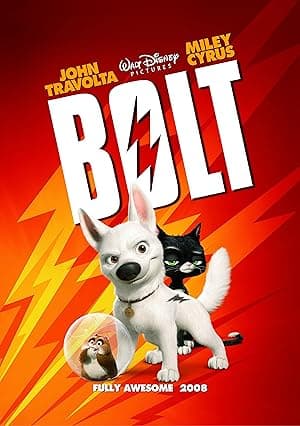
Bolt
A dog who thinks he’s a superhero learns the hardest trick of all: how to be real.
Feature presentation
Bolt still works because it asks a very simple question in a very direct voice: what happens when the world you were raised to believe in turns out to be make-believe? It dresses that question in chase scenes, jokes and an impossible-looking little hamster, then keeps its eye on the relationship at the heart of the fuss. Rewatching it now, Bolt feels like a neat, compact fable about loyalty, identity and the strange business of performance — with a warm centre that never lets the spectacle elbow the feelings off-screen.
THE MOVIE
Bolt is still the reason this movie works
What people remember most is obvious: a dog who thinks he’s a superhero. That’s not just a gag. Bolt’s literal belief in his own powers gives the whole film its engine — a dog raised on a TV set who genuinely expects the world to obey a script.
The film turns that premise into a road trip. An on-set cliffhanger convinces Bolt that Penny has been kidnapped, and he ends up shipped off the studio lot and into the real, un-scripted world. His certainty — that he’s heroic and must protect his person — is what moves the story and makes everything that follows feel earned.
That central idea arrives with a clear creative voice. Chris Williams and Byron Howard steer the movie, and John Travolta supplies Bolt’s voice, so the film isn’t shy about mixing proper action‑movie beats with quieter, character-first moments. The result is an animated family film that’s as interested in identity as it is in spectacle.
THE SETUP
The idea that sets Bolt in motion
At its simplest Bolt is a premise that can be explained in a line: a canine TV star raised to believe his stunts and powers are real is accidentally shipped out of the studio and has to find his way back to Penny. That one line carries both the joke and the consequence.
What holds the film together is how the central conflict is personal, not just plotty. Bolt has to recognise that the world doesn’t run on special effects, and that forces him to rethink what being a hero actually means while he tries to reunite with Penny.
The film leans into road‑movie mechanics to make those discoveries feel natural. Bolt becomes part of a mismatched trio — he, a cynical alley cat and a TV-obsessed hamster — and the episodic stops along the way double as short lessons for him and the audience.
That structure is familiar for a reason. There’s a sibling to this idea in Buzz Lightyear’s arc in Toy Story: a character has to reconcile on-screen identity with an off-stage self. Bolt borrows that dramatic trick and applies it to loyalty, trust and a very earnest dog.
THE CHARACTER
Why Bolt matters
Bolt matters because he’s written with a single, consistent logic: he was raised to believe in his heroism and he is, quite simply, earnest about it. That earnestness gives the film its emotional direction — he isn’t being funny on purpose; he genuinely thinks he’s protecting Penny.
That belief shapes every choice he makes. The stakes are small and very human: this dog wants to be useful to one person. His need to protect Penny is less about glory and more about belonging, which keeps the film grounded even when the action is brazen.
Bolt’s journey also gives the other characters something to play against. Penny is established as his emotional anchor and the reason he keeps going; Mittens, a world‑weary alley cat, provides the necessary contrast, shifting from cynicism to something like trust over the course of the trip.
And even the show’s villain — Dr. Calico — serves a purpose beyond shouting 'boo'. He stands for the fake dangers that shaped Bolt’s worldview, a reminder that the threats Bolt has fought his whole life were manufactured, which makes Bolt’s reckoning with reality quieter but also harder.
THE PERFORMANCE
Why John Travolta's performance matters
The production conversation around Bolt keeps circling back to one practical thing: the voice. John Travolta provides Bolt’s vocal presence, and both production materials and reviewers picked up on how that voice blends toughness with a tender, likeable quality.
That mix is useful because it lets the film have its action‑hero surface without losing the dog beneath it. Travolta’s voice gives Bolt authority when the story needs him to feel heroic, and it keeps him relatable when the script peels those moments back to reveal vulnerability.
It’s a neat trick for a family film: the vocal performance helps the audience take Bolt seriously as a character and not just as a gag. That balance matters to the tone — the movie needs you to root for him even after you realise the stunts are theatre.
So when the film asks Bolt to change — to accept help, or to discover courage that isn’t special-effects dependent — the vocal choices make those moments land. The voice is the bridge between the public Bolt and the private dog.
UNDER THE SURFACE
Bolt has more on its mind than the plot suggests
Perception versus reality is the engine under the jokes. Bolt’s entire life is a kind of media training: the show teaches him how to behave and the cameras reward him when he acts like a hero. The film then asks what happens when those rewards disappear.
That question naturally folds into identity and self-discovery. Bolt’s path isn’t a single revelation so much as a slowly widening awareness: that being heroic is a thing you can do without pyrotechnics, scripts or applause.
Friendship and loyalty follow. The film insists that bonds built from care and real dependence mean more than the staged loyalty of a show. The trio’s dynamics — especially the way Mittens shifts from sceptic to ally — underline that idea plainly and effectively.
Finally, there’s the film’s look at show‑business and artificiality. Bolt shows how production can package authentic feeling into entertainment, and it isn’t shy about suggesting that the people (and animals) inside that machine can be both exploited and redeemed by it.
THE FILMMAKING
How Bolt was put together
Bolt arrived after a bit of reshuffling behind the scenes. The project was reworked and completed under new creative supervision, with Chris Williams and Byron Howard credited as the directing pair after the earlier 'American Dog' phase was replaced.
The credits reveal a team built to cover both story and spectacle: Clark Spencer produced, John Powell composed, Tim Mertens edited, while Paul Felix and Adolph Lusinsky led art direction and look/lighting. That roster shows the film wasn’t a throwaway; it had a full-scale production apparatus behind it.
The directors divided responsibilities in a practical way that shows on-screen. Williams handled editorial, recording sessions and layout; Howard concentrated on animation, lighting and effects. The split explains why the film often balances tidy editing rhythms with confident animation beats.
Taken together, those choices point to a movie made to do two things at once: deliver polished animated sequences and keep a coherent emotional throughline. It’s a modest approach, but a deliberate one.
PRACTICAL EFFECTS
The effects work that gives Bolt its physical personality
Even as a CG feature designed for 3‑D, Bolt pays a lot of attention to the way characters look and move in space. Production notes emphasise work on character look, lighting and presentation to make fur, illumination and camera movement feel right for three‑dimensional exhibition.
That effort wasn’t purely cosmetic. The team meant for the visuals to support the story: believable fur and responsive lighting make quiet moments feel tactile, and the designed camera movement helps sell action beats without flattening the small, human-scale moments.
Voice work also fed back into the animation. Production documentation records that Travolta recorded multiple versions of lines and that those variations were used to shape Bolt’s on-screen behaviour — a reminder that animation was listening to performance and not the other way around.
So the movie’s physical personality is the product of two linked things: careful digital craft to make the world feel touchable, and an iterative relationship between vocal performance and animated action.
PURE 00s
Bolt could not belong to any other decade
Bolt is very much a late‑2000s picture: it came out in November 2008, at a time when studios were ramping up CGI family features and experimenting with 3‑D presentation. That context matters because the film was built with those exhibition strategies in mind.
Produced by Walt Disney Animation and presented at its premiere in a mix of 2‑D and Disney Digital 3‑D, Bolt sits alongside other studio efforts trying to find a new footing for animated features as the decade closed.
That industry moment explains some of the film’s priorities — clear, broadly readable character work, confident action sequences and a technical sheen designed to play in premium formats — without making the movie feel like a mere exercise.
Put simply: Bolt wears its decade on its sleeve in the sense that it’s a product of the late‑2000s push to marry character-driven storytelling with contemporary CG spectacle and 3‑D marketing.
WATCHING IT NOW
What has aged — and what hasn't
Many recent write-ups and contemporary review aggregates agree on two things: Bolt’s visuals and its character work remain among its strongest assets, and the movie is often seen as a modest creative rebound for Disney Animation in the late 2000s.
That matters when you sit down to watch it today. The animation still does its job: the characters read well, the emotional beats register, and the film’s clarity keeps it accessible to new viewers and familiar ones alike.
Thematically, the film’s concerns about identity, loyalty and the gap between performance and reality age well because they’re simple and human. Those ideas don’t rely on trends or jokes that would date quickly.
And for viewers who like extras, the Rhino short on the home‑video release is a nice, silly bonus that underscores the film’s affection for its own cartooniness without undermining the main story.
THE LEGACY
Why Bolt still matters
Bolt’s afterlife is tidy and specific. It earned industry recognition — including an Academy Award nomination for Best Animated Feature and Golden Globe nods — which keeps it in the conversation as more than just a passing piece of family entertainment.
It also has a place in histories of Disney Animation because it was the first feature produced under John Lasseter’s oversight; that positioning gives it extra weight as a turning-point title in the studio’s late‑2000s revival.
For fans of the characters, there was some follow-up life: a short called 'Super Rhino' arrived on the home‑video release, keeping at least one of the film’s goofier presences in circulation.
So Bolt matters because it represents a technical and creative moment for the studio, and because its emotional focus — on a dog and the person he loves — proved memorable enough to steady that reputation.
THE VERDICT
Does Bolt still hold up?
Yes. Bolt still holds up because its core is small, honest and well executed: a dog raised on a set believes the world runs on scripts, and his journey to accept the messy, unscripted world is both clear and moving.
The film keeps the stakes personal — Bolt is trying to reunite with Penny — and it never lets the spectacle drown out that central relationship. The contrast between staged action sequences and quieter real‑world moments is used to expose the manufactured nature of Bolt’s life while protecting the emotional thread of loyalty.
Visually and structurally the film benefits from a focused production: a directing pair who split practical duties, an emphasis on look and lighting for 3‑D presentation, and voice work that supports the animation. Those are the nuts and bolts that let the story breathe in ninety‑six minutes.
If you’re deciding whether to watch it now, think of Bolt as a compact, affectionate fable: not a groundbreaking masterpiece, but a film whose questions about who we are when no one’s rolling the cameras still feel, well, true. And that’s a good trick for a family movie to pull off.
Share this movie
Keep watching
More movies from the 00s
2002
The Pianist
A quiet life unmade by war — and a pianist who refuses to stop listening.
Read the retrospective
→
2006
Blood Diamond
A mercenary, a fisherman and a pink diamond — and a film that still asks who pays for our jewellery.
Read the retrospective
→
2003
Kill Bill: Volume 1
A yellow jumpsuit, a long list of enemies and one woman who refuses to be finished.
Read the retrospective
→