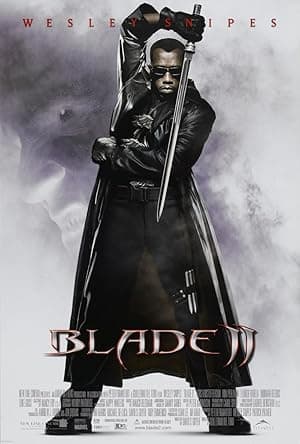
Blade II
Daywalker versus contagion: uneasy alliances, ugly mutations and a very particular 2002 swagger.
Feature presentation
Blade II feels like someone handed Guillermo del Toro a mean, mean comic-book and told him to have a good time. It’s a film about a lone hunter who will team up with his enemies when the thing hunting both of them is worse — and it still makes that gamble feel dangerous and combustible.
THE MOVIE
Eric Brooks / Blade is still the reason this movie works
There’s an immediately obvious centre to Blade II: a mission-focused daywalker who hates vampires but hates the idea of humanity getting eaten even more. That stubborn premise — Blade will cooperate with vampires if it saves people — gives the film its edge.
What pushes the story forward is a nastier kind of vampire: the Reapers, a mutated strain whose infection turns its victims into fast, animalistic predators. That mutation isn’t just wallpaper; it forces Blade into an uneasy alliance with parts of the vampire world he’d normally slaughter on sight.
And because Guillermo del Toro is in the director’s chair, the film never treats this alliance as tidy. It’s uncomfortable, tactical and volatile — which is exactly why the movie still crackles when you rewatch it.
THE SETUP
The idea that sets Blade II in motion
Blade II doesn’t bloat itself with side quests. It’s a mission movie: a new, lethal vampire strain appears and everything else flows from that one, urgent problem.
The Reapers’ biology and behaviour — they spread like a parasite or virus and turn vampires into something more lethal — is the sort of threat that makes old enemies trade fire for fragile cooperation.
So the plot moves from one set piece to the next: Blade and a vampire strike-team called the Bloodpack chase leads, infiltrate nests and confront mutated Reapers in staged action sequences rather than getting lost in detours.
That mission-structure works because it keeps the stakes tight and the central tension constant: can Blade trust these vampires long enough to stop a contagion that threatens both species?
THE CHARACTER
Why Eric Brooks / Blade matters
Blade is refreshingly simple in his demands: he protects humans and will do whatever it takes to stop threats to them. That clarity is rare and useful — it keeps the film’s moral geometry clean even when alliances get messy.
He’s the kind of lead who doesn’t make speeches about honour; he makes tactical choices, and those choices force the rest of the cast to reveal themselves. When vampires and humans collide, Blade’s position makes him the sensible centre of the chaos.
Part of what makes this iteration of the character stick is how he carries franchise weight without getting lost under it: this film sits inside the Blade series, but Blade himself remains the through-line across the trilogy.
That continuity matters. When you rewatch Blade II, you’re watching a character who’s already been shaped by earlier conflicts and who remains stubbornly the personification of purpose in a world full of shifting loyalties.
THE PERFORMANCE
Why Ron Perlman's performance matters
Dieter Reinhardt is one of those supporting parts that could have been decorative — instead he sticks in the memory. Contemporary and retrospective response singled Ron Perlman out as the actor who consistently owned the room among the supporting players.
That kind of scene-stealing presence is useful in a movie built from a series of alliances and belligerent personalities: when the supporting cast cuts through the noise, the film keeps its momentum.
Perlman’s casting gives the Bloodpack a voice that’s world-weary yet dangerous, which keeps the balance between threat and cooperation feeling credible.
Put bluntly: when a supporting actor repeatedly becomes the thing you remember after the heroes and monsters have gone, that’s working casting.
UNDER THE SURFACE
Blade II has more on its mind than the plot suggests
On the face of it, Blade II is an action-horror hybrid about stopping a new kind of monster. Underneath, it’s interested in messy moral math: when does survival justify trusting an enemy?
Mutation and contagion are central not simply as horror set-dressing but as a moral complication — the Reaper infection forces characters into choices that reveal who they are when their survival is on the line.
The film keeps returning to identity and otherness: born vampires, turned vampires, and a daywalker who belongs to neither world. Those boundaries are tested and blurred as the story progresses.
And throughout runs survival politics: vampire factions, the Bloodpack’s grudges and rivalries, and the compromises needed to deal with extinction-level threats. It turns a genre punch-up into a small, savage study of alliance and expedience.
THE FILMMAKING
How Blade II was put together
Blade II is an international production, and its Prague-based locations and Czech crews left a practical mark on the film. That Central European production footprint gives the movie a slightly different texture from a purely Hollywood shoot.
Production design leans on established genre instincts, mixing urban grit with gothic inflections to sell vampire lairs as believable hideouts rather than fantasy castles.
Those creature concepts and consultant-driven design choices are the scaffolding that lets the action and horror land: the world feels lived-in and consistent enough that the Reapers can be terrifying without the film losing its internal logic.
In short, the filmmaking choices are pragmatic and genre-aware, which is why the movie’s mood holds even when the plot accelerates into stunt sequences.
PRACTICAL EFFECTS
The effects work that gives Blade II its physical personality
Blade II relied on prosthetics and animatronics alongside digital work, which means a lot of the vampire transformations have tangible, on-set presence.
Practical make-up, contact-lens work and creature appliances were used to create the Reaper look and other vampire effects, supported by digital visual-effects houses for the more elaborate transformations.
That mix lets the film shift between a hands-on grotesque quality and the cleaner possibilities of digital augmentation, so the monsters sometimes feel physically real in close-ups and more otherworldly in broader shots.
The result is a tactile horror texture that helps sell the Reapers as a biological menace rather than merely a CG conceit.
PURE 00s
Blade II could not belong to any other decade
Arriving in March 2002, Blade II came at a moment when studios were experimenting with comic-book adaptations that leaned into genre mash-ups: action, horror and franchise potential all in one package.
That early-2000s context explains why a film like Blade II could be both a straightforward sequel and a director-driven genre experiment; studios were willing to back bold stylistic choices inside commercial franchises.
The movie sits squarely in that era’s appetite for darker, more violent comic adaptations, a time when a vampire action film could also be a test-bed for director-led creature work.
Put simply: Blade II is a product of a phase when mainstream cinema was more open to gritty, genre-forward superhero stories — and the film wears that era's ambition on its sleeve.
WATCHING IT NOW
What has aged — and what hasn't
The film’s central conceit — a mutated vampire strain that forces hostile cooperation — still works. Threats that erase the neat binaries between friend and foe have aged well as a dramatic engine.
The Bloodpack’s function as a vampire strike-team and the mission-structure that carries much of the plot also hold up: they give the movie forward momentum and a clear set of contests to follow.
Practical make-up and prosthetic work, combined with digital enhancements, give the Reapers a physical presence that helps the horror feel immediate even now.
And because the film foregrounds identity and otherness, those ideas remain resonant: a daywalker who lives between worlds still feels like a compelling figure for modern audiences.
THE LEGACY
Why Blade II still matters
The film helped raise Guillermo del Toro’s profile in Hollywood, which in turn led to later studio assignments — so it mattered for career trajectories as much as for fans of the series.
It’s frequently discussed as an early example of a stylised, director-driven comic-book adaptation, a model that later filmmakers and studio strategies would return to.
That combination — a commercially viable sequel that also bears a clear directorial stamp — is a useful piece of its afterlife: it showed that genre pictures could be both marketable and distinctive.
So Blade II matters not just as a sequel but as a signpost for how comic-book cinema could be handled with personality and bite.
THE VERDICT
Does Blade II still hold up?
Yes — but with a clear asterisk. If you want a tight, propulsive genre movie that prizes action, practical creature work and the thrill of dangerous alliances, Blade II still delivers.
The central idea is still effective: a mutated, virus-like Reaper threat forces Blade to cooperate with a vampire strike-team whose grudges and internal rivalries keep the tension live throughout the film.
Wesley Snipes’s Blade remains the mission-focused centre, and Abraham Whistler returns as the mentor and weaponsmith who keeps the practical side of the operation ticking. Those reliable through-lines stop the film from splintering amid the set pieces.
If you approach it as a 117-minute genre machine — part action, part horror, part superhero sequel — Blade II rewards a modern watch. It’s not flawless, but it’s still worth seeing for the way it stages moral compromise, contagion and a surprisingly functional mid-series character in real, stomping menace.
Share this movie
Keep watching
More movies from the 00s

2002
The Pianist
A quiet life unmade by war — and a pianist who refuses to stop listening.
Read the retrospective
→
2006
Blood Diamond
A mercenary, a fisherman and a pink diamond — and a film that still asks who pays for our jewellery.
Read the retrospective
→
2003
Kill Bill: Volume 1
A yellow jumpsuit, a long list of enemies and one woman who refuses to be finished.
Read the retrospective
→