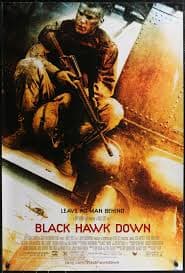
Feature presentation
Black Hawk Down is theatre of war built around small, urgent choices: a mission that goes bad, men who refuse to leave one another and a director who refuses to let you look away. Revisit Ridley Scott’s 2001 take on the Battle of Mogadishu and you’ll see why the film still gets talked about — because it gives you the confusion of urban combat and the stubbornness of brotherhood rolled into one long, relentless stretch of screen time.
THE MOVIE
SSG Matt Eversmann is still the reason this movie works
Black Hawk Down drops you into a narrowly drawn mission that goes horribly sideways: a seizure-and-capture raid on 2 October 1993 that becomes an eighteen‑hour urban fight when Black Hawk helicopters are brought down.
What saves the film from feeling like battlefield pornography is the way it refuses to treat the action as spectacle alone. Ken Nolan’s screenplay keeps the focus tight on task-force-level action — the immediate, terrifying work of getting men out alive — rather than a big political canvas.
That’s why SSG Matt Eversmann matters. He’s the platoon leader whose priority is simple and brutal: keep the men alive and obey the Rangers’ code, especially 'leave no man behind.' Under Ridley Scott’s control, that single-minded concern gives the film a human spine amid the chaos.
THE SETUP
The idea that sets Black Hawk Down in motion
The film stages the October 1993 U.S. operation in Mogadishu: a targeted raid whose start date on-screen is 2 October 1993. That clear window of time is important — the plot lives and dies inside that single operation.
The mission in the film is straightforward on paper: a capture-and-seize job against a warlord’s inner circle. What matters for the movie is what happens next, when the plan fractures and the story becomes a rescue-and-extraction fight.
Adapted from Mark Bowden’s non‑fiction book, Ridley Scott’s version refuses to widen the lens into long political backstory. The drama is tactical and immediate — men, streets, radios, smoke — and the screenplay keeps that pressure tight.
So, the setup works because the escalation is both believable and unstoppable: a small operation becomes a survival test, and the film mostly asks how soldiers behave in that squeeze rather than why the squeeze happened.
THE CHARACTER
Why SSG Matt Eversmann matters
Josh Hartnett plays SSG Matt Eversmann, the man who becomes the audience’s anchor in a very disorienting film. He’s the platoon leader who wakes up every decision with the same question: how do I keep these people alive?
That single question gives Eversmann shape. He isn’t a speechifying commander; he’s a leader tied to a code — the Rangers’ insistence on not leaving a buddy behind. In a movie crowded with names and faces, that clarity makes him memorable.
Eversmann also carries the film’s idea of brotherhood. When your storytelling choice is to keep things tight and tactical, you need a focal point that embodies unit cohesion — and that’s him.
In short: he matters because he turns the movie from a catalogue of firefights into a story about responsibility under fire. You follow him, and you understand what the men are fighting for.
THE PERFORMANCE
Why Josh Hartnett's performance matters
Contemporary reviewers noticed Hartnett in the part. Several critics singled out specific actors, and Hartnett’s steadiness as the mission-focused platoon leader was a frequent remark.
That kind of notice matters because the movie depends on at least one clear centre to hold the rest of the ensemble together. When the battle becomes confusing, having a figure who consistently thinks about the men under him gives the audience somewhere to stand.
Saying critics praised Hartnett’s steady presence isn’t the same as saying he turns the film into something it isn’t. It is, however, a useful reminder that this is a crowded movie and a calm focal point helps the chaos cohere.
Put simply: if the film’s moral choice is ‘leave no man behind,’ Hartnett’s role is the visible expression of that choice — and contemporary reaction noted that.
UNDER THE SURFACE
Black Hawk Down has more on its mind than the plot suggests
On the surface it’s an action picture about a mission gone wrong. Underneath, it’s interested in the stubborn things people do for one another: brotherhood and unit cohesion are threaded through every choice the platoon makes.
The film also wants you to feel the chaos of urban warfare — the confusion, the randomness, the way plans dissolve when a city refuses to behave like a clean battlefield. That messiness is part of the point.
Closely related is duty and sacrifice. The movie repeatedly shows decisions shaped by a code: stay with the team, help the wounded, get people out. Those choices are what make the action feel like drama rather than noise.
Finally, there’s a running tension between high‑tech military capability and its limits. The helicopters, radios and planning matter, but the story quickly shows how technology can’t always control a city, or a crowd, or fate.
THE FILMMAKING
How Black Hawk Down was put together
From its cutting to its sound mix, the film’s technical craft was repeatedly singled out when it first came out. Contemporary reviews praised the way editing, cinematography and sound work together to make the viewer feel embedded in the fighting.
That attention to craft paid real dividends: the film left with Academy recognition in technical areas, including wins for Film Editing and Sound at the Oscars.
But the storytelling choices that make the battle feel immediate also expose a weakness. The same critics who admired the staging often criticised the movie for keeping political context at arm’s length and for how Somali combatants were depicted.
So you get immersive, sequence-driven battle realism — and the side effect is that some viewers wanted a fuller conversation about why events happened, not just how they were fought.
PRACTICAL EFFECTS
The effects work that gives Black Hawk Down its physical personality
The movie doesn’t fake the streets. Production teams built large practical sets recreating Mogadishu in Morocco, and large-scale live action sequences — helicopters, vehicles and pyrotechnics — are central to its physical feel.
That practical ambition is visible in the way sequences play: there’s a tactile, physical quality to the fighting that comes from the production actually staging complex activity rather than suggesting it off‑screen.
Producers also acknowledged cooperation and technical support from the U.S. Department of Defense and the U.S. Army for parts of the production, which helped with access to equipment and technical know‑how.
All of that adds up to a film that looks and sounds like a large, carefully staged military operation — which is exactly what the story asks the audience to believe.
PURE 00s
Black Hawk Down could not belong to any other decade
Released at the end of 2001, Black Hawk Down arrived into a changed political moment: its limited December release expanded in January, placing its rollout shortly after September 11 and into a different conversation about American military films.
It’s also very much of an early‑2000s sensibility: alongside other late‑90s and early‑00s war films, it favoured visceral, immersive battle sequences and ensemble military storytelling that put you on the ground rather than at headquarters.
Ridley Scott made this as part of a run of large‑scale, technically ambitious studio movies around 2000–2001. That production DNA — big staging, careful craft — ties it to the moment.
So while the movie’s subject is 1993, its texture and reception are rooted in the turn of the millennium, when filmmakers and audiences wanted frontline immersion and a certain kind of muscular filmmaking.
THE LEGACY
Why Black Hawk Down still matters
Part of the film’s continuing presence comes from formal recognition: it received multiple Academy Award nominations and won two Oscars for Film Editing and Sound.
It also kept cropping up on 'best of' lists for its year, which is one reason people still point to it when talking about early‑2000s war cinema.
The subject even crossed into other media — a commercially released video game carrying the Black Hawk Down name arrived in 2003 — showing there was sustained public interest in the story.
Taken together, awards, critical lists and cross‑media attention explain why the film hasn’t quietly faded: people still return to it when they want a particular kind of battle movie.
THE VERDICT
Does Black Hawk Down still hold up?
Yes — with a clear rider. If you want to feel the claustrophobic, chaotic reality of a narrowly framed operation that turns into an eighteen‑hour rescue-and‑extraction ordeal, this film still delivers. The movie stages the 2 October 1993 operation and keeps its focus on the tactical scramble that follows when helicopters are downed.
Its strengths are the things it set out to do: tight, sequence-driven battle realism; a moral throughline about brotherhood and the imperative to not abandon a comrade; and a central platoon leader, SSG Matt Eversmann, whose concern for his men gives the film its emotional anchor.
You should also go in aware of the trade-offs. The screenplay deliberately narrows its scope away from extended political background, and contemporary reviewers noted both how brilliantly the film is staged technically and how limited its contextual picture of the wider conflict can be.
So if your aim is to be on the ground — to watch command decisions, unit cohesion and the tension between technology and the messy reality of urban combat — Black Hawk Down remains worth watching. If you want a full political accounting of the operation, you’ll find the film intentionally parsimonious. Either way, it still puts you in that long, exhausting fight and makes you care who comes out of it.
Share this movie
Keep watching
More movies from the 00s

2002
The Pianist
A quiet life unmade by war — and a pianist who refuses to stop listening.
Read the retrospective
→
2006
Blood Diamond
A mercenary, a fisherman and a pink diamond — and a film that still asks who pays for our jewellery.
Read the retrospective
→
2003
Kill Bill: Volume 1
A yellow jumpsuit, a long list of enemies and one woman who refuses to be finished.
Read the retrospective
→