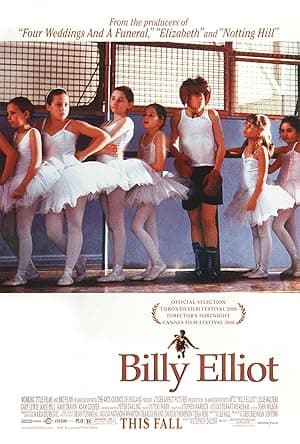
Billy Elliot
A working-class coming-of-age about a boy who trades gloves for dance shoes and refuses to apologise for wanting more.
Feature presentation
Billy Elliot still lands because its centre is simple and stubborn: an eleven-year-old who stumbles into ballet and refuses to stop being himself. Stephen Daldry stages that leap—literally and emotionally—against the pressure of a mining town on strike, so the personal always feels plugged into real stakes. It's a small story with a loud heart, and you can see why so many people keep returning to it.
THE MOVIE
Billy Elliot is still the reason this movie works
If you can remember one image from Billy Elliot, it's probably not a picket line or a council office. It's the boy. Jamie Bell's Billy is the insistence at the heart of the film: a kid who spends money meant for boxing lessons on a ballet class and, in doing so, changes everything around him.
That small act reads like rebellion because Daldry places it inside a community under real pressure — a County Durham mining town during the 1984–85 miners' strike — so Billy's wish to dance isn't a hobby, it's a route to something different. The choice matters because the world he wants to leave is loud and limiting.
What keeps the movie moving is how plainly it sets those pieces up: a child discovering a new language of expression, a family shaped by work and pride, and a director willing to let the boy be the thing the audience hangs on. Put like that, the film's 110 minutes feel less like a period drama and more like a conversation started by a single brave kid.
THE SETUP
The idea that sets Billy Elliot in motion
The engine of Billy Elliot is almost delightfully simple: an eleven-year-old watches a ballet class, pays for a lesson with money intended for boxing and, from that cheeky swap, finds a language that finally fits him. That early choice launches everything that follows without needing clever tricks.
From there the film defines its drama in clear terms. Billy wants to pursue dance; his father and brother expect him to follow the town’s masculine script, made sharper and angrier by the miners' strike. Those opposing pulls — personal aspiration versus family and community pressure — keep the story honest and urgent.
The stakes are concrete too: an audition for the Royal Ballet School becomes the film's measuring stick. It's the thing that turns private practice into public risk, and it gives the final act a clean shape so the emotional pressure can play out on a visible stage.
Daldry balances quiet kitchen-table moments with bigger public set pieces — pickets and confrontations — so Billy's private ambitions never feel detached from the world he’s trying to leave. That mix is what makes the setup work: intimate and rooted at the same time.
THE CHARACTER
Why Billy Elliot matters
Billy matters because he is a point of refusal. He refuses the tidy options the town hands him: the boxing gloves, the predictable path. What he accepts instead — a form of art that his family and neighbours view with suspicion — forces everyone around him to negotiate who they are.
That negotiation is personal. Jackie, his father, carries pride and fear sharpened by economic strain; Tony, his older brother, enforces the local idea of masculinity. Their resistance is recognisably social, not cartoonish, which is why Billy's insistence on dancing feels dangerous and brave in equal measure.
Billy isn't the only kid on screen who complicates the town's script. Michael, his friend, offers another way of being that sits differently to the dominant norms. Together they make the town's rules feel less inevitable.
And none of that would have landed without the casting work behind the film: Jamie Bell was found after a huge search that looked at thousands of boys, and the production's concentrated work with child actors is one reason the character's choices feel lived-in rather than plotted.
THE PERFORMANCE
Why Jamie Bell's performance matters
Contemporary notices singled out the central young cast for giving the film its emotional charge, and Jamie Bell is the pillar of that response. The attention he received at the time isn't an empty footnote: it explains why audiences found Billy believable rather than merely a plot device.
That early acclaim helped the film feel immediate rather than constructed — people believed the boy at the centre, and that belief is contagious. When the story asks you to care about his choices, you do, because the casting and the performances made you do it.
It's worth remembering that the movie's power depends on the audience taking Billy seriously. The contemporary response to Bell and his co-stars shows the casting and direction achieved that, which is no small feat for a film built around a child taking extraordinary emotional risks.
So when you watch Billy Elliot now, part of its durability is down to that initial critical notice: the film arrives with an agreement already in place — that the boy at its heart is worth following.
UNDER THE SURFACE
Billy Elliot has more on its mind than the plot suggests
On the surface it's a coming-of-age tale about talent and an important audition. But the film is quietly interested in how identity is policed. Masculinity and gender norms are constant pressure-cookers in the story: the town has expectations, and the drama comes from who chooses to obey them and who doesn't.
Class and community are never wallpaper. The miners' strike is the social weather the characters live under, so personal choices arrive against a background of economic anxiety and collective anger. That context means Billy's choices read differently than they might in a wealthier setting.
Mentorship matters too. The relationship with the dance teacher turns aspiration into a teachable craft; it converts raw need into something that can be argued for, practiced and presented. Education here is both literal and moral.
Finally, art in Billy Elliot is a way to speak when words won't do. Dance operates as a form of expression that reveals what the characters can't otherwise name, and that honesty is what gives the film its emotional authority.
THE FILMMAKING
How Billy Elliot was put together
Stephen Daldry's approach to building the film is quietly disciplined. He deliberately kept camera movement in check, working with his cinematographer to avoid over-stylisation so the story stayed clear and immediate.
That restraint matters because the movie's emotional beats are small and domestic; when the camera steps back the performances and the moments speak for themselves. The result is a film that feels straightforward without ever being dull.
The dance sequences are treated as story action rather than spectacle. Choreography isn't decoration; it's the way Billy says things he can't say in words, and the filmmaking supports that by letting the dancing function as narrative.
Those choices — controlled direction, an emphasis on story-led movement — are what give the film its distinct identity. It doesn't shout stylistically; it prefers clarity so the characters can do the work.
PURE 00s
Billy Elliot could not belong to any other decade
Billy Elliot sits neatly in a late-90s/early-2000s wave of British films that looked back to northern working-class communities and found stories that combined social realism with uplift. Think of it alongside films like The Full Monty and Brassed Off — different plots, similar cultural curiosity.
Its timing matters. Released in 2000, the film arrived when British cinema was comfortable telling small, character-led stories with a national ear. That context gave it room to be both local in its detail and broad in its human appeal.
The film's afterlife — a stage musical that premiered in the West End in 2005 — also ties it to the era's taste for adapting intimate screen stories into something larger and more public. The move from screen to stage felt like a natural extension of the film's appetite for performance as transformation.
So while Billy Elliot is very much a personal story, it also belongs to a moment in British cinema when films about ordinary communities were a prominent way to ask big, human questions.
THE LEGACY
Why Billy Elliot still matters
Part of the film's staying power is plainly factual: it didn't disappear after its first run. It was adapted into a West End musical in 2005 and later moved to Broadway, where the stage version won significant theatre awards. That transformation underscores how the story lends itself to performance and public reinvention.
The movie also arrived with awards attention at the time — including major nominations and BAFTA recognition — which helped cement its place in conversations about British cinema of that period.
And on a career level, the film served as an obvious launchpad for the young actor at its centre and remains one of Stephen Daldry's best-known film projects. Those threads — stage life, awards, career beginnings — are concrete reasons the film hasn't been forgotten.
Taken together, Billy Elliot's legacy is less about a single claim to greatness and more about the ways the story kept moving: from screen to stage, and from a local tale to something with broader theatrical life.
THE VERDICT
Does Billy Elliot still hold up?
Yes. Billy Elliot still works because its core elements are simple, well arranged and emotionally honest. The inciting act — a boy swapping boxing lessons for ballet — remains a vividly economical decision that sets up the film’s central conflict between personal aspiration and community expectation.
The story keeps its stakes recognisable: a Royal Ballet School audition gives the narrative a clear target, while the miners' strike provides a social frame that makes private choices feel public. Those two tracks — the intimate and the communal — remain persuasive.
The relationships keep the film grounded too. Mrs Wilkinson functions as the mentor who turns Billy's need into a teachable craft, and the pressures from Jackie and Tony supply conflict that is both personal and social. Dance sequences do the emotional talking the characters struggle to voice.
If you haven't seen it for a while or are meeting it for the first time, watch it for the way a small, concrete decision grows into something that changes a family and a town. Billy Elliot doesn't reinvent the coming-of-age wheel — it simply gives it a very human push.
Share this movie
Keep watching
More movies from the 00s
2002
The Pianist
A quiet life unmade by war — and a pianist who refuses to stop listening.
Read the retrospective
→
2006
Blood Diamond
A mercenary, a fisherman and a pink diamond — and a film that still asks who pays for our jewellery.
Read the retrospective
→
2003
Kill Bill: Volume 1
A yellow jumpsuit, a long list of enemies and one woman who refuses to be finished.
Read the retrospective
→