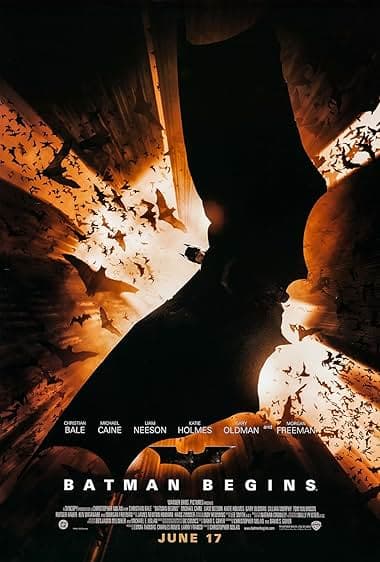
Batman Begins
A serious, grown-up origin story that builds Batman out of choices, not gadgetry.
Feature presentation
Batman Begins didn't arrive to reinvent capes so much as to remind us why Bruce Wayne became one. Christopher Nolan turned the origin into a study of trauma, training and methodical preparation — a film that treats fear as a weapon and symbolism as a decision. Rewatching it now, you notice how deliberately it constructs Batman from ethical questions and practical steps rather than comic-book wizardry.
THE MOVIE
Bruce Wayne / Batman is still the reason this movie works
Batman Begins works because its central problem is not 'can he punch better than the bad guys?' but 'what does Bruce Wayne make of his pain?' The film traces Bruce's journey from the childhood trauma of seeing his parents killed, through years of training abroad, and back to Gotham where he chooses to wear a symbol and use it against organised crime and a conspiracy built around fear.
That combination — a personal vendetta turned into a deliberate public persona — keeps the picture sharp. Nolan and his co-writer give Bruce an identity crisis: is he an avenger, a deterrent, or something closer to a civic idea? The movie makes that question feel like the plot's engine rather than an afterthought.
All of this is framed with an insistence on plausibility. Nolan treats the Batman kit and the Tumbler as repurposed prototypes, and the film spends time on the steps — training, equipment and investigations — that explain how a billionaire might actually become a vigilante.
THE SETUP
The idea that sets Batman Begins in motion
At its simplest, Batman Begins is built on a double life: Bruce Wayne moves through the public world as a billionaire and secretly operates as a vigilante. That duality isn't treated as mystical — it's logistical. The screenplay lays out the procedural steps that get him from one to the other.
So the film spends time on the nuts and bolts: how suits are made, where vehicles come from and how training produces competence. Presenting Batman’s tools as military or corporate prototypes rather than magic keeps the story rooted and believable.
This realism isn't a stunt. It gives weight to the idea that someone could, by choice and method, assemble an identity capable of changing how a city sees crime. The setup sells you the possibility before asking you to accept the symbol.
UNDER THE SURFACE
Batman Begins has more on its mind than the plot suggests
On the surface it's an origin movie. Underneath it's about how trauma and choice combine to create a persona. Bruce is not born Batman; he constructs Batman as a way to convert survivor guilt into a preventative force.
Fear is threaded through the film as both a tactic and a subject. The Scarecrow and his fear-device make that literal, but the movie also asks what it means for someone to weaponise terror in order to fight terror.
Vigilantism sits uneasily here. The film deliberately raises the moral question: when you step outside the law to stop a greater wrong, what are you willing to become? That ambiguity keeps the story from becoming simple hero worship.
Finally, the insistence on realism — training, equipment, explanation — gives the themes purchase. By refusing to paper over logistics with fantasy, the film forces its ethical questions to sit next to concrete choices.
THE FILMMAKING
How Batman Begins was put together
Nolan and his production team aimed for a grounded, urban Gotham. That wasn't just a visual choice; it shaped how scenes were constructed — often leaning on full-scale sets and real locations to support the film's practical feel.
Where possible, Nolan preferred in-camera tricks and tangible staging over doing everything in post. That approach informs the film's texture: sequences are often arranged to play out physically, which underlines the movie’s insistence that this Batman is built, not conjured.
The filmmaking approach shows up in the storytelling rhythm too. When equipment and training are part of the narrative, the camera work and production design have to support plausibility rather than spectacle alone.
PRACTICAL EFFECTS
The effects work that gives Batman Begins its physical personality
The movie uses a hybrid effects strategy: full-scale sets, detailed miniatures and practical stunts sit alongside targeted digital work. The mix keeps sequences tactile without pretending everything was achieved without a computer.
The Tumbler and other vehicles were realised as practical builds with multiple scales for different shooting needs. That physical presence helps sell stunt sequences and close-up interaction with the machinery.
Specialist visual-effects houses supplied several hundred shots to augment the practical work, while pyrotechnics and miniature photography contributed to the film’s physicality. The result reads as a carefully balanced combination rather than an either/or choice between models and CGI.
PURE 00s
Batman Begins could not belong to any other decade
Arriving in 2005, Batman Begins rebooted a franchise that felt dormant after the previous, more flamboyant entries. It came at a moment when Hollywood was recalibrating comic adaptations toward grittier, more realistic takes.
The film's production as a U.S.–U.K. co-production and its focus on adult dramatic weight fit a broader early-2000s industry trend: comic-book properties were being reimagined as serious, franchise-ready drama rather than pulpy oddities.
Seen in that light, Batman Begins feels very of its moment — part of a shift that treated superheroes as characters you could interrogate rather than only celebrate.
WATCHING IT NOW
What has aged — and what hasn't
The fear motif remains sturdy. Presenting fear as both a tactic (the Scarecrow’s airborne agent) and a philosophical problem still gives the film a core that plays cleanly to modern viewers.
The Scarecrow’s dual role as Arkham psychiatrist and villain — and the recurring use of his fear device — keeps the psychological through-line coherent. You can watch the movie and still feel that its anxiety-driven beats land.
Where the film might feel less sharp is not in its ideas but in how thorough it is: the heavy focus on explanation and procedure can feel deliberate in an era that often prefers faster beats. But that very thoroughness is also what makes the origin believable.
THE LEGACY
Why Batman Begins still matters
Batman Begins matters because it relaunched the Batman franchise with a clearly articulated approach and directly set up the sequel that followed. It wasn't a tweak; it was a reset that insisted Batman could be treated as serious drama.
The film is often noted by critics and scholars for steering superhero cinema toward more realistic, character-focused territory in the mid/late 2000s. That shift is part of how the movie is remembered in industry conversations.
Beyond those arguments, the production itself formed recurring collaborations — with crew members and a stylistic playbook — that Nolan carried into later films, which helps explain the trilogy's cohesive feel.
THE VERDICT
Does Batman Begins still hold up?
Yes. Batman Begins still works because it gives you a believable route from trauma to symbol. The film traces Bruce Wayne’s arc — from the witnessed murder of his parents to overseas training and a return to Gotham — in a way that feels intentional rather than convenient.
Its refusal to lean on unexplained supertechnology matters. The movie shows Batman assembling his kit from repurposed prototypes, and Lucius Fox’s role in supplying material means anchors the transformation in plausible logistics rather than fantasy shorthand.
Crucially, the moral argument is clear: Bruce’s actions are driven by survivor’s guilt and a wish to prevent others suffering what he suffered, and that ethical tension — between becoming a symbol or becoming a punitive force — still reads as interesting today. Alfred’s steady counsel and the mentor-turned-antagonist arc also give the film the emotional structure it needs.
If you’ve never seen it, watch it for the way it builds a hero from choices and methods. If you’re revisiting, watch it to remember that Batman began as a careful thought experiment about fear, responsibility and how a man decides to stand between a city and its worst impulses.
Share this movie
Keep watching
More movies from the 00s

2002
The Pianist
A quiet life unmade by war — and a pianist who refuses to stop listening.
Read the retrospective
→
2006
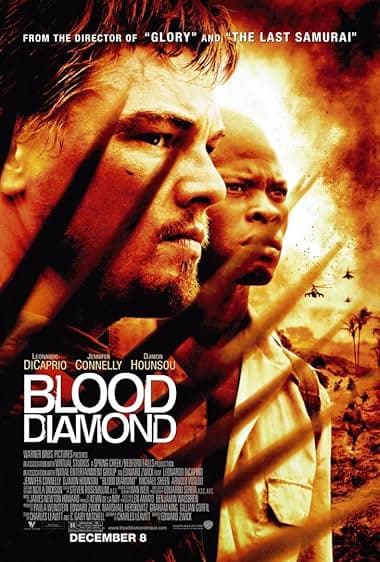
Blood Diamond
A mercenary, a fisherman and a pink diamond — and a film that still asks who pays for our jewellery.
Read the retrospective
→
2003
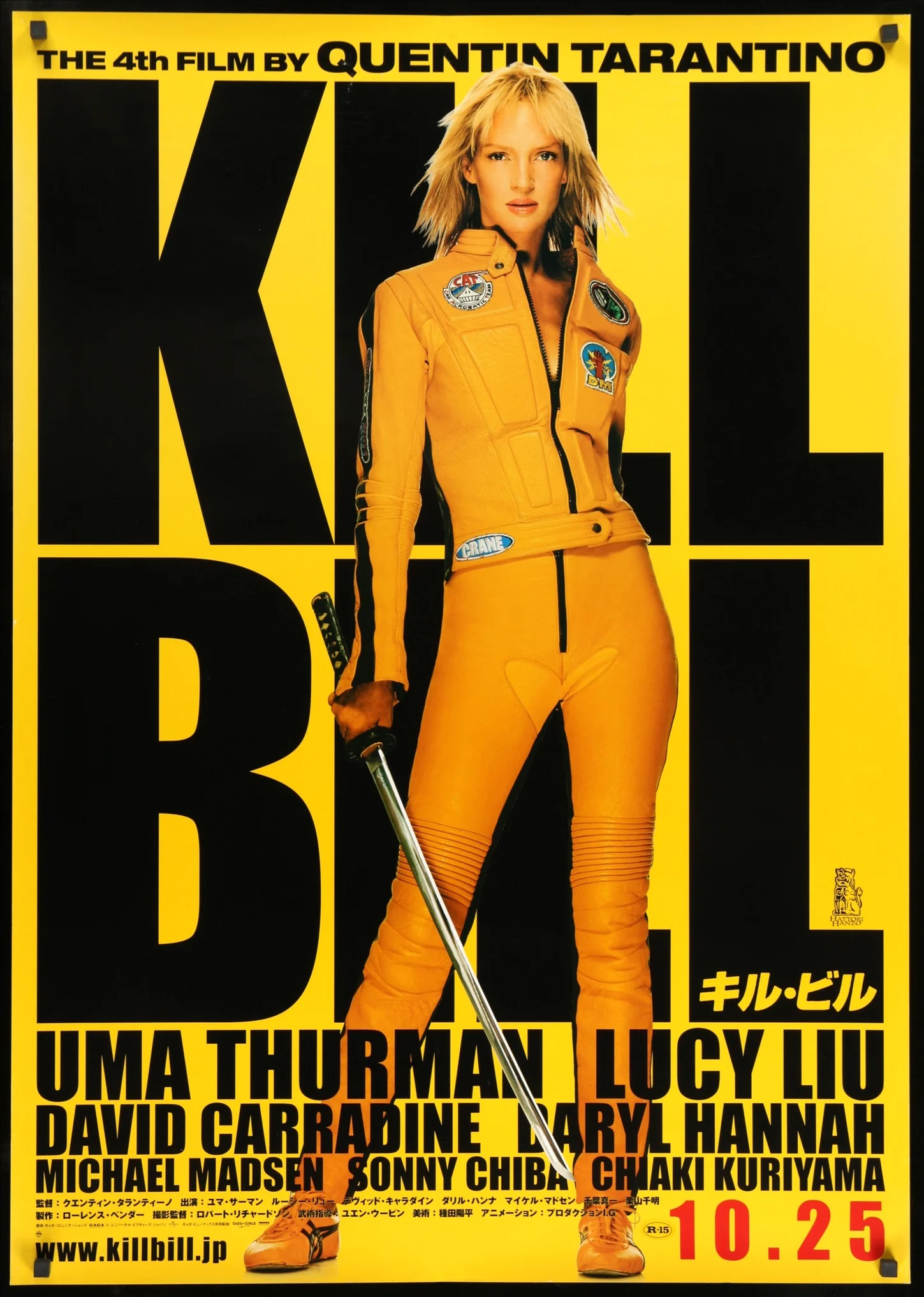
Kill Bill: Volume 1
A yellow jumpsuit, a long list of enemies and one woman who refuses to be finished.
Read the retrospective
→