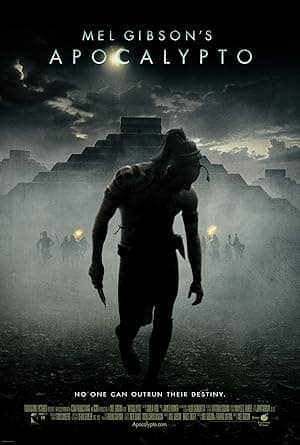
Apocalypto
A terrifying chase, a father's stubborn hope, and a waterfall jump you don't forget.
Feature presentation
Apocalypto is the kind of film that arrives shouting: a village raid, a frantic escape and a single man sprinting for his family through jungle and ruin. It’s a visceral, old-fashioned pursuit story shot with 2000s digital bravado — and Jaguar Paw is the reason you keep watching.
THE MOVIE
Jaguar Paw is still the reason this movie works
From the first beat Apocalypto picks a simple, stubborn centre: a small forest village, a hunter called Jaguar Paw and a family to be protected. You don’t get coy exposition; the movie drops you into a community and then into the chaos when raiders arrive to take people away.
That raid is the engine. It’s violent and immediate, and its purpose is blunt — people are seized to be ferried to a distant city for ritual sacrifice — so the film converts a cultural catastrophe into a very human problem: get back to your family, or lose them.
Jaguar Paw, played by Rudy Youngblood, is built to carry that problem. He’s a physically capable hunter with a pregnant wife and a small son; his choices are always measured against them. Mel Gibson wrote and directed the picture with that single-person urgency in mind, and it’s why the film still feels like it’s moving toward something specific rather than simply staging set pieces.
THE SETUP
The idea that sets Apocalypto in motion
Apocalypto keeps its concept economical. A peaceful, forest-dwelling Maya community is invaded; survivors are taken toward a large city to be used in public rituals. That violent inciting incident gives the movie an obvious goal — escape and return — and the rest of the picture is how Jaguar Paw tries to make that goal real.
The film’s narrative is essentially a long chase. Jaguar Paw’s survival is a literal sprint: jungle, captured columns, the overcrowded city, and then back into the wilderness. Because the plot follows a single man’s flight, the scale of the world is mostly felt through the obstacles he encounters rather than through wide historical explanation.
This tight focus works because the personal is clear. The central conflict is physical — outpace your pursuers, stay alive — and emotional — get back to your loved ones. The film layers the survival story over a larger frame about a civilisation that’s frayed at the edges, but it never allows the broader backdrop to swallow the simple urgency up front.
THE CHARACTER
Why Jaguar Paw matters
Jaguar Paw is the movie’s anchor in the most literal sense: the entire film bends around his need to protect a pregnant wife and a child. That makes him easy to root for — his motivation is immediate, non-negotiable and recognisable even without words.
He’s also defined by practical things the story trusts: skill as a hunter, physical resilience and the bonds to his father and community that establish what he stands to lose. Those ties — particularly the relationship with his father, Flint Sky — give the opening moments warmth and weight, which the later chase then steadily corrodes.
Everything else in the cast largely exists to set the chase in motion or to be an obstacle: auctioneers, temple figures, pursuers and companions along the route. That concentration is purposeful. By keeping peripheral characters functional, the film preserves Jaguar Paw as the emotional and narrative compass.
THE PERFORMANCE
Why Rudy Youngblood's performance matters
When a film asks you to spend two hours with one protagonist largely without lengthy dialogue, the performer’s presence becomes everything. Contemporary coverage singled out Rudy Youngblood as a striking discovery who carries that burden.
That attention isn’t just celebrity-making; it’s practical. The film depends on a believable physicality and a sense that the character truly loves the people he’s trying to reach. Much of the audience’s investment begins and ends with Youngblood’s ability to make Jaguar Paw feel like a living person rather than a plot device.
UNDER THE SURFACE
Apocalypto has more on its mind than the plot suggests
On the surface, Apocalypto is a chase movie. Underneath, it frames that chase against bigger ideas: the idea of a civilisation fraying from within, where ritualised violence and public sacrifice are signs of a society in trouble.
The film is also a nature-versus-civilisation tale. The jungle is survival and immediacy; the city is ritual, spectacle and a civilization that’s beginning to rot. By setting a man raised in the forest against urban machinery, the story invites the audience to feel how those worlds clash.
There’s another layer, too: fate and prophecy. The film suggests forces beyond the immediate hunt — patterns that push people toward particular ends — and that sense of inevitability sharpens the tension between what Jaguar Paw can control and what history seems to demand.
Put simply: the movie stages a very small human struggle inside a much larger collapse. That choice gives the chase moral and historical weight without turning the picture into a lecture.
THE FILMMAKING
How Apocalypto was put together
Apocalypto was an early big-studio experiment with high-definition digital capture: principal photography used the Panavision Genesis camera, and that decision gives the film a particular immediacy — a sharpness to faces and foliage that feels very of its moment.
Gibson and Dean Semler also used elevated tracking moves during production, employing a suspended camera system for long overhead shots and dynamic following takes. Those choices give some chase sequences an almost airborne momentum, which keeps the pursuit from feeling visually repetitive.
Production design plays its part, too. The movie recreates a small forest village and a sprawling Postclassic-style city, with art direction shaping the contrast between intimate domestic spaces and ritualised public architecture. The team credited Dean Semler as DP, John Wright as editor and Tom Sanders as production designer.
Sound and makeup were recognised in awards season as well — the film received nominations for sound editing, sound mixing and makeup — which underlines how many hands were working to make the world feel tactile and lived-in.
PRACTICAL EFFECTS
The effects work that gives Apocalypto its physical personality
A lot of what reads as spectacle in Apocalypto is physical staging. The film relied on stunt work and choreographed crowd movement, training a large number of extras so collapses, slogs and stampedes would read as a single, frightening organism.
One of the sequences people still talk about was shot at a genuine waterfall and involved harnessing and stunt coordination. The waterfall jump isn’t a digital afterthought; it’s a staged stunt that roots the film’s more extreme moments in something you can almost feel under your boots.
PURE 00s
Apocalypto could not belong to any other decade
There’s a particular mid-2000s energy here: big-location shoots, shoots overseas, and a willingness to test new digital formats on a major production. Apocalypto was released in 2006 and often crops up in conversations about Hollywood taking digital cinematography seriously at scale.
That technical curiosity sits beside an appetite for large, international storytelling — the film shoots in remote regions and stages sequences that demand real-world logistics. These were both hallmarks of cinema in the mid-00s: grand, adventurous, occasionally bruising projects that wanted to feel immediate and authentic.
WATCHING IT NOW
What has aged — and what hasn't
There’s still muscle to the movie’s chase and survival elements: the structure that keeps the film moving — a single man fleeing, surviving and trying to return — remains a simple, effective cinematic promise.
At the same time, the film’s representation of history has not stopped being contested. Scholarly and journalistic retrospectives continue to discuss its portrayals of Maya culture and its relationship with archaeology and cultural sensitivity, which means modern viewings often include that extra, unavoidable context.
So while the visceral thrills and technical choices can still land, viewers today will also bring a more critical eye to what the film says — and what it leaves unsaid — about the people and the world it depicts.
THE LEGACY
Why Apocalypto still matters
Apocalypto remains a talking point for two main reasons. First, its technical ambition: shooting on high-definition digital cameras, staging large location shoots and foregrounding practical stunt work made it a noticeable production in the mid-2000s conversation about how big films could be made differently.
Second, it provoked debate. Contemporary filmmakers and critics have kept returning to the film when discussing how mainstream cinema represents indigenous cultures and where responsibility lies in historical storytelling. Those debates are part of the film’s afterlife, as much as any nominations it picked up.
It’s worth noting the film’s craft did receive institutional recognition: it earned multiple major awards nominations in the 2006–2007 season, including Academy nods for sound and makeup and a Golden Globe nomination for Best Foreign Language Film.
THE VERDICT
Does Apocalypto still hold up?
Yes — with qualifications. If you want a lean, brutal chase movie centred on a single, driven character, Apocalypto delivers. The story is plain and powerful: a village raid propels Jaguar Paw into a long pursuit, and the film keeps that personal mission front and centre as he fights to return to his wife, Seven, and their child.
Rudy Youngblood’s Jaguar Paw is the film’s beating heart; the narrative’s momentum depends on him and the clarity of his goal. Mel Gibson’s direction keeps the sequence work relentless and focused, moving from jungle to city and back again so the stakes — both physical and emotional — never slacken.
Where the film’s legacy complicates a recommendation is in its historical framing. The movie places a personal survival tale within a broader picture of civilisation in decline, and modern viewers should be ready to watch both the thrilling chase and the contested ideas that surround it.
So watch it for the chase, the production craft and the stubborn human centre. But watch it aware: Apocalypto will still make your pulse race, and it will probably make you think — which, for better or worse, is part of its point.
Share this movie
Keep watching
More movies from the 00s

2002
The Pianist
A quiet life unmade by war — and a pianist who refuses to stop listening.
Read the retrospective
→
2006
Blood Diamond
A mercenary, a fisherman and a pink diamond — and a film that still asks who pays for our jewellery.
Read the retrospective
→
2003
Kill Bill: Volume 1
A yellow jumpsuit, a long list of enemies and one woman who refuses to be finished.
Read the retrospective
→