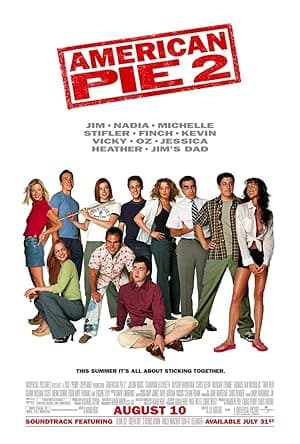
American Pie 2
A summer house, a big party plan — and Jim Levenstein's clumsy, very human pursuit of confidence.
Feature presentation
American Pie 2 isn't subtle, and it doesn't pretend to be. What it does have is a premise that anybody who's ever been twenty-something will recognise: five mates home for the summer, a rented lake house and a plan to turn a stalled night into a whole season of possibilities. Right in the middle of that mess is Jim Levenstein, still figuring out how to be grown-up without losing all the embarrassment that made him, well, Jim.
THE MOVIE
James 'Jim' Levenstein is still the reason this movie works
American Pie 2 kicks off with a simple, irresistible summer promise: five friends rent a Lake Michigan beach house for the months after college and set out to turn a shut‑down party into a whole "summer of love." It's the kind of setup that lets the film be rowdy and episodic while keeping the stakes personal — sex, friendship and whether anyone will come out of the summer feeling a bit less clueless.
That set piece logic — you solve money, you rent the place, you set the party as the destination — is the movie's engine. It gives the characters room to chase separate goals without turning the film into anything more complicated than it needs to be: a comic, sometimes daft, coming‑of‑age about people testing themselves outside the campus bubble.
And at the centre of it all is Jim Levenstein, written as the young man who spends the summer trying to grow some sexual confidence. Jason Biggs plays the part readers will remember: not a fantasy hero but the kind of awkward, hopeful bloke whose failures and small victories the film bets we will care about.
THE SETUP
The idea that sets American Pie 2 in motion
The film's inciting practical decision is almost painfully ordinary: a party gets shut down, the group needs a new plan, so they rent a lake house and agree to make the summer count. That one move supplies a clear place to play and one obvious deadline — the big end‑of‑summer party — which works nicely for a comedy built from episodes rather than a single mystery.
Once the house is in play, the film divides into a handful of objectives. Some characters are after romantic closure, others want the confidence to sleep with someone new, and everyone is chasing some version of the same basic prize: not being the person they were on graduation day.
Those aims are pursued through a series of set pieces that mostly work like comic checkboxes: jobs to raise rent money (painting houses, among other chores), misunderstandings that spiral, and sex‑related gags timed to escalate toward the party. It’s tidy scaffolding for screenplay choices that put the laughs before long arcs.
Because it’s a direct sequel to the first film, the setup assumes a bit of backstory and keeps the momentum moving forward: same core group, same problems, but with a summer house as the new playing field.
THE CHARACTER
Why James 'Jim' Levenstein matters
Jim is the awkward compass of the whole film. He's not written as the slick prize of the group; he's the one still learning how to navigate sex and intimacy without turning every attempt into a humiliation. That makes him surprisingly sympathetic in a movie that otherwise celebrates bravado and bad decisions.
Jason Biggs plays Jim, and the screenplay gives him room to be the friend who trips over himself while the others chase different versions of success. Jim's arc is recognisably about learning — very slowly — how to put himself forward without losing sight of the people around him.
The film also keeps Jim embedded in a network: his father Noah appears as part of his life, and the group’s dynamics mean his failures land against friends who are also trying to figure things out. Those relationships stop Jim being a one‑note joke and let him count as the film’s emotional anchor.
Because the movie carries male friendship as one of its themes, Jim matters not only for his individual journey but for how his awkwardness tests and tightens the group. He’s the fulcrum between comic set pieces and the film’s quieter, human moments.
UNDER THE SURFACE
American Pie 2 has more on its mind than the plot suggests
On the surface it’s about sex, and there’s no pretending otherwise. Underneath that, the film is centrally preoccupied with the awkward business of sexual coming‑of‑age: the fumbling attempts at initiation, the bravado that hides insecurity and the rare small victories that actually count.
Male friendship is another steady current. The five friends are still negotiating who they are now that college has ended; their identities and rivalries persist, but so does a loyalty that keeps the film from collapsing into outright nastiness.
There’s also a running tension between commitment and casual sex. Some characters are chasing immediate conquest, others want something more meaningful, and the film stages that disagreement as both comic fuel and emotional friction.
Those three ideas — learning to be sexual, sticking together as a group, and choosing between casual flings or something real — give the film a spine. They stop the party gags from being purely shallow and make certain choices land with more weight than a quick laugh.
THE FILMMAKING
How American Pie 2 was put together
The movie’s crew list reads like a commercial comedy’s who’s who: cinematography by Mark Irwin, production design from Richard Toyon, editing by Larry Madaras and Stuart H. Pappé, and music credited to David Lawrence. Those names are the practical backbone of any mainstream comedy — they shape how jokes land and how the summer‑house world feels coherent.
The practical facts matter because American Pie 2 is basically a sequence of comic setups: the way scenes cut, how locations are dressed and how music bridges moments all keep the film moving across its 107 minutes without getting bogged down.
Production‑design choices, for instance, let a single location serve many purposes: poolside lark, awkward private encounters, or full‑scale party mayhem. The editing team stitches those beats into a rhythm that reads as continuous fun rather than a string of sketches.
Put simply: the film relies on solid, unflashy filmmaking — the routine craft moves that let a comedy be loud, nimble and comprehensible to a wide audience.
PURE 00s
American Pie 2 could not belong to any other decade
This is very much an early‑2000s sequel: it follows the original 1999 film and keeps working the R‑rated teen/sex comedy lane that the first movie helped revive. That continuation — same characters, same appetite for boundary‑pushing jokes — is textbook franchise thinking of the time.
Its opening weekend set a then‑record for an R‑rated comedy, which says less about artistic merit and more about the era’s appetite for this kind of crude, crowd‑pleasing fun. The film was part of a string of big summer releases for Universal in 2001, and it fit the studio’s calculation for profitable, mass‑market entertainment.
The movie was released in 2001, and production used multiple Southern California locations to stand in for a Midwestern Lake Michigan beach house — another practical move that typifies studio filmmaking of the period: create the feeling of place without being tied to it.
Seen in context, American Pie 2 is a product of its moment: sequel culture, commercially minded summer scheduling and a willingness to let gross‑out humour exist alongside a recognisable coming‑of‑age story.
WATCHING IT NOW
What has aged — and what hasn't
The film’s basic identity — a teen movie built on male friendship — keeps a surprising amount of its energy. The group‑dynamic stuff, the familiar ribbing and the way characters lean on one another still reads as recognisable; friends behaving badly but ultimately sticking together is not a period trick, it's just human.
As a sequel that carries characters forward from the first film, it rewards viewers who remember the earlier instalment. That continuity gives some moments extra weight, because these are not brand‑new faces learning everything at once; they're a group with history.
If you’re the sort of viewer curious about casting curiosities, American Pie 2 includes a few names that have become interesting in retrospect: Casey Affleck appears as Tom Myers and Eli Marienthal is credited as Matt, Stifler's brother. Those bits are neat to spot, but they don’t fundamentally alter the film’s experience.
Finally, anyone watching now should know there are two cuts of the film: the theatrical R‑rated release and a later unrated version for home video. For viewers deciding how to revisit it, that availability means you can choose the slightly fuller home‑release cut if you want the most complete version.
THE LEGACY
Why American Pie 2 still matters
On release it was the second theatrical entry in the franchise and, for its initial run, the highest‑grossing film in the series. That commercial success is part of why it remained visible: it wasn't a niche sequel, it was a mainstream summer performer.
The movie also sits in the franchise timeline as the chapter before American Wedding (2003), and the series went on to spawn further theatrical sequels as well as direct‑to‑video spin‑offs. American Pie 2 thus helped sustain a continuing commercial property rather than being a one‑off curiosity.
Beyond box office, the film’s soundtrack and some of the title releases were commercially issued, and the movie received home‑video releases in both its theatrical R‑rated cut and an unrated version — later seeing a Blu‑ray release. For many viewers, home formats were how the film found and kept its audience.
Put simply: its legacy is partly financial and partly practical. It kept the franchise alive and it was available in multiple versions, so people could watch, rewatch and pass it along — the easiest path for any comedy to remain in the public memory.
THE VERDICT
Does American Pie 2 still hold up?
If you’re after a subtle, modern rom‑com about twenty‑somethings, this probably isn’t your first stop. But if you want a loud, frequently foolish take on the awkward business of becoming an adult, it still has a useful heartbeat. The film’s structure — a summer house rented after a party is shut down, episodic jobs and gags leading to one big party — is basic and it works for what the movie sets out to do.
At its centre is Jim Levenstein: a man written to earn sexual confidence over the summer. That throughline gives the humour something to bounce off rather than just repeating tricks. The tension between characters chasing casual sex and others seeking commitment adds a bit of emotional friction beneath the jokes.
There are two versions available — the theatrical R‑rated cut and an unrated home‑release — so modern viewers can pick how frank they want their revisit to be. And because this is the sequel that carries familiar characters forward from the first film, it rewards anyone who wants to follow the group’s story into the next instalment.
So, should you watch American Pie 2 today? Yes, if you can accept a noisy, occasionally crude comedy that places male friendship and awkward coming‑of‑age at its heart. It’s not delicate; it’s frequently ridiculous. But it still does what it promises: a messy summer of attempts, friendships that survive the mess, and Jim trying, again and again, to be a little less mortified than he was yesterday.
Share this movie
Keep watching
More movies from the 00s

2002
The Pianist
A quiet life unmade by war — and a pianist who refuses to stop listening.
Read the retrospective
→
2006
Blood Diamond
A mercenary, a fisherman and a pink diamond — and a film that still asks who pays for our jewellery.
Read the retrospective
→
2003
Kill Bill: Volume 1
A yellow jumpsuit, a long list of enemies and one woman who refuses to be finished.
Read the retrospective
→