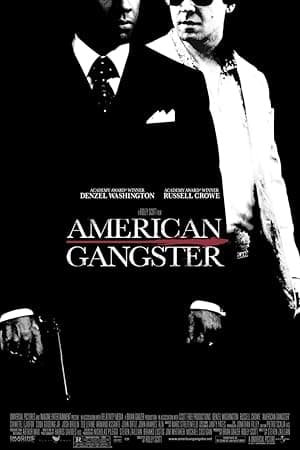
American Gangster
Harlem business, American ambition — and the price of running a very illegal company.
Feature presentation
American Gangster still lands because it treats Frank Lucas less like a caricature and more like a businessman with a ledger. Ridley Scott stages a late‑60s/early‑70s crime epic that runs two parallel tracks: Denzel Washington’s Lucas climbing a violent ladder while Russell Crowe’s Newark detective follows the paper trail. That tidy premise — commerce grafted onto crime — is why the film keeps a grip on you even now.
THE MOVIE
Frank Lucas is still the reason this movie works
What keeps American Gangster moving isn’t the action set pieces or the mid‑2000s star billing; it’s the way the story puts Frank Lucas at the centre of everything. The film dramatizes his rise and fall in Harlem, tracing how a single operator built a heroin supply chain across continents and into American streets.
Ridley Scott and a long runtime give the screenplay room to run two tracks in parallel: Lucas’s entrepreneurial ascent in organised crime and Richie Roberts’s investigation that tries to untangle the business. That framing turns criminality into a form of logistics and status — buying a house for one’s mother sits next to shipment manifests and smuggling routes.
Put simply: Denzel Washington’s Frank Lucas anchors a film that wants to be a portrait of ambition, not just a list of crimes. The director and the leads (including Russell Crowe as the other half of the narrative equation) keep the movie focused on how commerce and corruption feed one another.
THE SETUP
The idea that sets American Gangster in motion
The film’s engine is practical and almost mundane: Frank Lucas cuts out middlemen by sourcing heroin directly from Southeast Asian producers and slipping it into the United States on returning service planes. It’s a grimly efficient business model, and the screenplay keeps coming back to that method as the thing that makes Lucas dangerous and durable.
Two inciting moves kick the drama into life. Lucas’s mentor dies, leaving a gap in Harlem’s criminal order, and across town a shaken police department finds Richie Roberts pushed onto an anti‑corruption and narcotics task force after internal disputes. From there the movie sets up a classic chase: a private supply chain against a public investigation.
The investigation itself is procedural rather than sensational. It advances through informants, undercover work and wiretaps, the kind of police work that lingers over paperwork and surveillance rather than chase sequences. Key beats — identifying a final shipment, planning a raid, taking apart the processing operation — give the film its forward motion.
And when the net finally tightens, the legal aftermath is as significant as the arrests: trials, pleas and cooperation that pull corrupt officers into the light. The film doesn’t simply end with a single bust; it shows the ripple effects when a structured criminal business meets the law.
THE CHARACTER
Why Frank Lucas matters
Frank Lucas matters because he turns criminality into commerce. The film presents him as an entrepreneurial, status‑conscious operator who thinks like a businessman: control the product, control the supply chain, and present success as uplift — buying a house for his mother, for example, is part of that image.
That combination of family concern and cold calculation gives the character weight. His personal ties — his mother and his marriage to Eva — aren’t window dressing; they are stabilising centres that inform why he takes certain strategic steps and how he measures success.
Around him are people who act like corporate staff: brothers, lieutenants and rivals who expand his reach but also become points of vulnerability. When the investigation closes in, those operational extensions are the weak links that expose the whole enterprise.
Ultimately Frank is memorable because the film treats him as someone building something — a business shaped by loyalty and family as much as by brutality. That makes him a stranger to simple moral labels, which is exactly the kind of character this long, methodical story needs.
THE PERFORMANCE
Why Ruby Dee's performance matters
Ruby Dee’s role as Mahalee Lucas functions as more than a background presence in the household of a rising crime figure. Her part anchors the family side of the story, reminding the audience that Lucas’s ambitions have domestic consequences.
Contemporaneous attention singled out Dee’s work: critics and awards bodies gave the role recognition, indicating that her turn was a stabilising, notable presence within the larger ensemble.
That sort of recognition matters in a film that balances business manoeuvres with personal stakes. When the movie asks us to understand why Lucas does what he does, the scenes that involve Mahalee supply the human counterweight.
So even when the screenplay measures success in shipments and ledgers, Mahalee is a reminder that those figures sit beside a living family — and that’s part of why the role gained awards notice.
UNDER THE SURFACE
American Gangster has more on its mind than the plot suggests
Beneath heists and raids, American Gangster is quietly arguing that race and American capitalism are braided together. The screenplay’s author framed the story in terms of American business and race, and the film keeps returning to the idea that criminal markets often mirror legitimate commerce.
That leads directly into the film’s moral fog. It doesn’t set up tidy heroes and villains; instead it runs two parallel lives — the criminal entrepreneur and the lawman — and shows how both are working inside compromised systems. There’s moral ambiguity on both sides.
Corruption and complicity are woven through the plot: the investigation uncovers not only criminal activity but also the ways law enforcement can be compromised. The movie is interested in the structures that make that possible, not just in individual bad actors.
Finally, family and loyalty thread through everything. Whether it’s Lucas buying for his mother or the way his crew is organised, personal ties justify business choices. That human dimension softens the economics without excusing it, and it’s one reason the film keeps returning to its characters rather than treating them as set dressing.
THE FILMMAKING
How American Gangster was put together
Ridley Scott assembled familiar collaborators to build a convincing period world: the production emphasised production design and period costumes to evoke late‑60s and early‑70s Harlem, and the crew shot much on location around New York with separate sequences filmed in Thailand for the Southeast Asian/Vietnam segments.
Those choices are practical ones: the movie needed to sell a believable international supply chain and a specific era, so location work and design were essential rather than decorative.
Behind the camera the film relied on recurring members of Scott’s team — Harris Savides on principal photography, Pietro Scalia handling the edit and Arthur Max as production designer — names that helped shape the film’s steady, deliberate surface.
And the result translated into recognition: the film earned a substantial box‑office return and also received awards attention that included nominations for supporting acting and art direction, which speaks to both the performances and the film’s crafted look.
PURE 00s
American Gangster could not belong to any other decade
This film’s DNA is mid‑2000s studio ambition: it spent years in development before reaching production in the mid‑2000s and arrived at a time when studios were willing to back large, adult‑oriented period dramas with substantial budgets.
A reported production budget of around $100 million places it firmly among those tentpole‑priced adult dramas of the era — movies that wanted both prestige and reach.
That budgetary and production confidence also shaped how critics talked about the film. Contemporary coverage frequently compared American Gangster to earlier gangster touchstones and to other high‑profile mid‑2000s crime dramas, placing it within a conversation about revisiting and reworking classic genre tropes.
Released in 2007, it sat neatly in a decade that liked to re‑examine crime cinema with big production values and a willingness to turn true stories into sprawling studio pictures.
WATCHING IT NOW
What has aged — and what hasn't
Some of what keeps American Gangster watchable today is basic and stubborn: its family thread. The film’s attention to family and loyalty still gives the narrative human stakes that don’t feel dated; those relationships help the movie avoid being a dry account of transactions.
On the other hand, it’s a long film. The theatrical cut runs to 157 minutes, and that length is part of the bargain—there’s space for the parallel investigations and for the slow build of Lucas’s system. If you prefer a tighter pace, be aware the film asks for patience.
For viewers who want more context, the home‑video release later offered an unrated extended edition with additional footage and an alternate ending — a reminder that there is a deeper cut for those willing to dig in.
So the film’s strengths age fairly cleanly: the human material and the institutional picture remain compelling. The cost is the runtime, which still divides viewers between those who relish the long take and those who’d rather the story been leaner.
THE LEGACY
Why American Gangster still matters
The film mattered at the box office: it returned a healthy worldwide gross against its large production price tag, which meant its blend of prestige and crowd appeal paid off commercially.
It also left a footprint in awards season and popular culture. The movie picked up multiple major nominations — including film‑craft recognition — while Ruby Dee’s supporting role earned industry awards attention and a Screen Actors Guild win.
Home‑video amplified that afterlife: the release included an unrated extended edition and sold strongly on DVD at the time, giving audiences extra routes to engage with the story beyond cinemas.
There was a cultural echo as well: the film directly inspired a contemporaneous Jay‑Z concept album titled American Gangster, issued the same month in 2007 and tied to the movie’s themes and tone.
THE VERDICT
Does American Gangster still hold up?
Yes — with qualifications. If you want a film that treats criminal enterprise as a kind of business study, American Gangster delivers: it dramatizes Frank Lucas’s rise and fall and keeps the mechanics of his operation front and centre, from direct sourcing of heroin in Southeast Asia to the smuggling on service planes.
The twin narrative strands — Lucas building a structured illegal business and Richie Roberts tracing that organisation through investigation — give the film its sustained tension. The movie isn’t interested in moral simplicity; it wants to show how both sides operate inside compromised systems, and that moral ambiguity still reads clearly.
Practical patience is required. At 157 minutes the theatrical cut asks for time: there’s payoff if you engage with the slow accumulation of detail, and there’s an extended home‑video edition if you want even more depth.
Ultimately, if you’re drawn to crime stories that treat their subjects as makers of systems rather than mere thugs, American Gangster remains worth watching. It’s a study in ambition and complicity — and Frank Lucas is the reason to watch.
Share this movie
Keep watching
More movies from the 00s
2002
The Pianist
A quiet life unmade by war — and a pianist who refuses to stop listening.
Read the retrospective
→
2006
Blood Diamond
A mercenary, a fisherman and a pink diamond — and a film that still asks who pays for our jewellery.
Read the retrospective
→
2003
Kill Bill: Volume 1
A yellow jumpsuit, a long list of enemies and one woman who refuses to be finished.
Read the retrospective
→