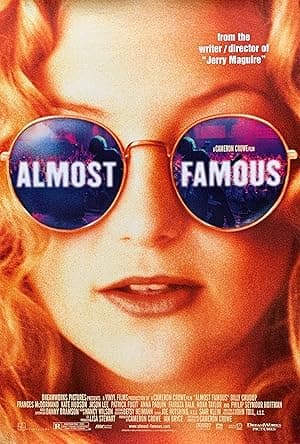
Feature presentation
Almost Famous is Cameron Crowe’s affectionate, semi-autobiographical love letter to rock journalism and the messy adults who orbit it. At its centre is William Miller, a teenager who wins a ticket to a band’s tour and finds that the work of loving music can demand as much bravery as any stage dive.
THE MOVIE
William Miller is still the reason this movie works
There are plenty of good reasons people keep returning to Almost Famous, but none of them outshine the obvious one: the whole film runs on William Miller. He’s a precocious fifteen-year-old who wins an assignment that lands him on tour with a rising rock band and gives him the chance to write his first proper magazine profile.
The movie isn’t only about groupies or guitar solos; William wants to write honestly about the music he loves, and that hunger steers everything he does. Along the way he meets mentors and warnings — most notably the rock critic who turns up at two decisive moments to tell him not to get too cosy with his subjects.
Put like that, it sounds simple. But Cameron Crowe — who wrote and directed the film and draws openly on his own teenage reporting — uses William’s journey to weigh loyalty against truth, and to make the film feel like an initiation rather than a nostalgia trip.
THE SETUP
The idea that sets Almost Famous in motion
At its core Almost Famous gives us a neat, irresistible premise: a teenage music fan is given the professional chance to travel with a band and write about them. That neatness is useful — it keeps the movie mobile without flattening the complications that come later.
William’s tour with Stillwater is part education, part rite of passage. The narrative frames the road as a classroom where music, friendship and temptation all count as lessons; writing the piece is the task that forces William to decide what he owes to the band, to his editors, and to himself.
Penny Lane arrives as more than a romantic subplot — she’s the charismatic leader of a group of fans who function as William’s guides into the band’s world. Her presence helps explain how William learns the rules of belonging, even if those rules are sometimes messy.
And there’s a clear structural tug-of-war: William wants to produce a warts-and-all profile, but pressures from both the band and the magazine complicate whether that honesty ever sees print. That conflict is what keeps the story moving without turning it into a straight-up backstage tour.
THE CHARACTER
Why William Miller matters
William could have been a plot device — the kid who sees it all and reports back. Instead he feels like the film’s emotional barometer because his motives are so plainly readable: he wants to belong and he wants to write the truth about the music that made him who he is.
That makes his choices watchable. When he’s dazzled by the band’s charm or tempted to protect them, we understand the stakes: honesty versus loyalty, a paper deadline versus an emerging adulthood. The drama comes from him trying to hold both values at once.
Family also matters to William’s portrait. His relationship with his mother — who appears loudly and clearly as a protective, outspoken parent — spells out the generational distance between home and the road. It helps remind us that William’s coming-of-age is not only musical; it’s domestic and moral too.
The film even shows younger versions of him, underlining that this is a formative episode rather than a one-off adventure. That layering keeps William anchored as a teenager learning to measure his impulses against consequences.
UNDER THE SURFACE
Almost Famous has more on its mind than the plot suggests
On the surface it’s a road movie about a young writer and a rock band. Underneath, it’s mostly about initiation: how a teenager becomes an adult through work, mistakes and the music that shapes him. That coming-of-age base is the film’s consistent beat.
Closely tied to that is the question of authenticity versus fame. The movie places those ideas in friction: the band’s public image and private life often don’t match, and William is the one asked to notice and record the mismatch.
Music and fandom are treated as serious forces, not mere window dressing. The film shows being a fan as a kind of education — a way into a community that offers belonging but also the risk of losing the ability to see clearly.
Finally, mentorship threads through the story. William learns from older figures who warn him away from getting too close, and those lessons shape the way he decides to tell the band’s story. It’s a film keenly interested in how integrity is taught, and how easily it can be compromised.
THE FILMMAKING
How Almost Famous was put together
Cameron Crowe didn’t come to this story as an outsider. The film is explicitly semi-autobiographical — the sort of project where the director’s own past work-life becomes a structural and emotional scaffold for the drama.
That personal connection helps explain the film’s attention to journalistic detail and the way scenes read less like set pieces and more like memories. It gives the story a lived-in logic: William’s decisions feel like they’re rooted in real experience rather than pure invention.
On a technical level the movie was shot on 35mm Eastman film and credited John Toll as director of photography, which contributed to its tactile, cinematic look. Editing was handled by Joe Hutshing and Saar Klein, and the cutting received its own recognition with an Academy Award nomination.
Those production choices — the material film stock and the editing craft — are the quieter scaffolding behind a story that wants to feel immediate and, at times, confessional.
PURE 00s
Almost Famous could not belong to any other decade
Although the story looks back at the early 1970s, the film itself is unmistakably a product of 2000. Crowe’s tidy, reflective framing treats the era as something to be recalled and curated rather than simply reproduced.
That curatorial impulse was most visible in the soundtrack, which the industry noticed: the film’s compilation won the Grammy for Best Compilation Soundtrack Album, a nod to how central music selection is to the whole experience.
It also mattered in the way the film was received at launch. Premiering at a major festival and rolling out to New York and Los Angeles in September 2000, the movie arrived at a moment when audiences were happy to indulge a nostalgic, music-rich take on coming-of-age storytelling.
In short, Almost Famous looks backward for material but speaks with a 2000s sensibility about how stories of youth and music should be packaged and remembered.
WATCHING IT NOW
What has aged — and what hasn't
A lot of films that trade on nostalgia feel fragile over time, but Almost Famous has stayed in circulation enough that theatres, festivals and home-video releases keep bringing it back to viewers. That continued presence suggests people still find something to want from it.
Part of its durability is the simplicity of the central situation: a teenager on tour trying to write his first major piece. That premise remains clear and immediate, which helps newer audiences follow the emotions without needing decades of cultural context.
The film’s semi-autobiographical roots also help it hold together. Knowing it comes from lived experience gives its scenes a credibility that pure pastiche would lack, and that keeps the emotional moments from feeling purely constructed.
That said, it’s a film anchored to the rituals of print journalism and the romantic language of rock fandom. If you’re watching from a culture shaped by streaming playlists and viral clips, some parts read as period detail — but ones that tell a story about devotion, not just aesthetics.
THE LEGACY
Why Almost Famous still matters
There are a few tidy markers that explain the film’s afterlife. Cameron Crowe won the Academy Award for Original Screenplay, and the film collected three Oscar nominations in total — recognition that kept the movie in serious conversation beyond fan circles.
The soundtrack’s Grammy win underlines a different kind of legacy: this is a film whose music curation became part of its identity, not just background noise. The songs and how they’re assembled matter to why people revisit it.
Finally, the decision to turn the property into a stage musical more than a decade later points to a story that can be reshaped for different formats without losing its essential emotional core.
Taken together, awards, a celebrated soundtrack and a theatrical afterlife explain why Almost Famous continues to circulate in both industry and audience conversations.
THE VERDICT
Does Almost Famous still hold up?
Yes — mostly. If you come for music, character and the peculiar thrill of watching a teenager try to remain honest in a flattering, flattering world, Almost Famous still delivers. The premise is simple and durable: a young writer on tour, trying to write an honest profile while navigating loyalties and seduction.
The film’s moral friction — the mentor who warns William not to get close, the band’s charm that complicates the story, Penny Lane and her band-aids who shepherd him into the scene — gives the movie its emotional tension. Those elements combine to make the coming-of-age arc feel active rather than merely nostalgic.
It also helps that the film treats family and journalism as part of the same education; William’s relationship with his outspoken mother keeps the story grounded and reminds viewers that growing up is messy in real life, not just on stage.
So should you watch it? If you like films about music, fandom and the awkward business of becoming an adult — told with care and a clear point of view — Almost Famous remains worth your time. It’s not a perfect memory of a vanished era; it’s a personal one, and that gives it the honesty it asks of its protagonist.
Share this movie
Keep watching
More movies from the 00s
2002
The Pianist
A quiet life unmade by war — and a pianist who refuses to stop listening.
Read the retrospective
→
2006
Blood Diamond
A mercenary, a fisherman and a pink diamond — and a film that still asks who pays for our jewellery.
Read the retrospective
→
2003
Kill Bill: Volume 1
A yellow jumpsuit, a long list of enemies and one woman who refuses to be finished.
Read the retrospective
→