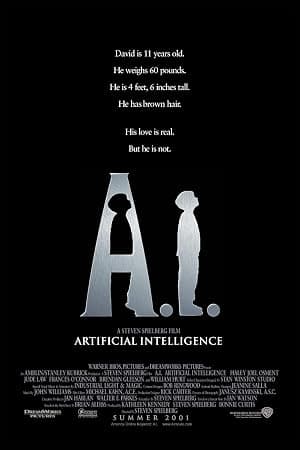
A.I. Artificial Intelligence
A manufactured child's longing, a Pinocchio road-trip and a Spielberg film that still asks what makes us human.
Feature presentation
If you remember one thing about A.I. Artificial Intelligence it’s probably David: a childlike mecha whose programming is heartbreakingly simple — be loved back. Steven Spielberg built a big, strange movie around that single request, steering from suburban domesticity out into spectacle and a far-future frame that keeps nudging you to ask what counts as real. That focused lack of guile is exactly why the film still rewards a rewatch.
THE MOVIE
David is still the reason this movie works
A.I. centres on David, an advanced childlike android sold on one programmatic truth: he can love and he expects it in return. That tidy emotional engine — a manufactured being driven by the need for reciprocal affection — is the movie’s simplest and most persuasive idea.
What gives the film its grim humane edge is how that programme collides with ordinary parenting. Monica and Henry adopt David while their real son is incapacitated; once their family dynamics change, David is returned to his makers and, rather than face destruction, is abandoned with other obsolete machines. The domestic decision ripples outward, and Spielberg lets that single act of abandonment anchor a very big story.
This is Spielberg’s film, yes — but it carries Kubrick’s fingerprints too: treatments and ideas left behind by Stanley Kubrick shaped the material Spielberg completed. That dual lineage is part of the movie’s personality — an earnest moral centre inside a cooler, more questioning frame — and it’s why people keep coming back to it.
THE SETUP
The idea that sets A.I. Artificial Intelligence in motion
At the film’s core is a clear storytelling choice: give an artificial child an imprinting protocol that makes him single-minded about one human — his adoptive mother. That structural simplicity keeps the film emotionally readable even when the locations and stakes get wildly bigger.
David’s literal take on fairy tales — he believes Pinocchio can make him a real boy — supplies the quest engine. From that naïveté come episodic encounters that test and clarify what his programmed loyalty actually means, and those episodes let the film move from family kitchen to spectacle without losing its emotional compass.
The movie pairs David’s innocence with the grubbier, more worldly figure of Gigolo Joe, who becomes a companion for part of the journey. Their mismatch — earnest devotion alongside survival instincts — gives the road-trip moments texture.
Finally, the story’s geography matters: it’s domestic, then spectacular (Rouge City, the flooded ruins of New York) and then oddly patient with the long view. That sweep frames the human/mecha questions inside a society changing by environment and population, which makes the personal stuff feel consequential.
THE CHARACTER
Why David matters
David is memorable because his wants are simple and readable. He’s an android built to love, and that single, unambiguous drive makes every choice he makes feel inevitable — not mysterious.
His emotional transparency lets the movie ask blunt questions about care. Monica’s ambivalence — real maternal feeling tangled with a need to protect her biological child — turns the family into a moral pressure cooker. The stakes are domestic, and that keeps the philosophical stuff human-sized.
David isn’t the only viewpoint; Teddy, his constant companion, externalises David’s inner life and preserves the film’s emotional tone when plot pushes outward. And Gigolo Joe acts as the foil: his worldliness bounces off David’s innocence, showing how different kinds of artificial lives navigate a human world.
Put simply: the movie gives us a character whose program is heartbreakingly narrow, then watches how the wider world responds. That contrast is the whole point.
THE PERFORMANCE
Why Haley Joel Osment's performance matters
Contemporary critics singled out the central performance as crucial to how the audience reads David. Roger Ebert in particular emphasised Osment’s role in anchoring viewer empathy and how that sympathy complicates the film’s ethical questions about a machine that appears to feel.
That production choice mattered upfront: Stan Winston was at one point commissioned to build an animatronic David, but the production shifted toward using the actor himself — a decision that shapes how the character reads on screen. The presence of a child actor, rather than a doll, keeps David relatable even when the plot becomes strange.
Because the film relies on a human centre, it lets the spectacle happen around a recognisable emotional core. The contrast between technique and performance is one reason David’s predicament feels immediate rather than abstract.
Put another way: how we believe David is as important as what happens to him, and the production choices that foreground the actor play straight into that gamble.
UNDER THE SURFACE
A.I. Artificial Intelligence has more on its mind than the plot suggests
At face value it’s a Pinocchio tale — a manufactured child wants to be ‘real’ — but the film layers that myth over questions about artificial personhood and empathy. The simple demand for reciprocal love becomes a test case for whether empathy depends on origin or behaviour.
Parenthood is at the film’s moral heart. Monica’s torn instincts — genuine care counterbalanced by protective preference for her human son — force the audience to reckon with abandonment as a lived choice, not just a dramatic twist.
The Pinocchio motif runs deep: David’s literal belief in a fairy tale keeps the story readable, but it also frames transformation as something more mythic than scientific. The quest isn’t merely functional; it’s ritualised longing.
Finally, the film glances at commodification: bodies and emotion are marketable in this world, and the Flesh Fair spectacle is a blunt reminder that artificial lives can be consumed as entertainment. Those ideas give the movie an emotional bite beyond its central love story.
THE FILMMAKING
How A.I. Artificial Intelligence was put together
The film is a careful construction: Janusz Kamiński shot it and Michael Kahn cut it, while production design and large-scale stage work were used to create Rouge City and the flooded New York sequences. Those choices let Spielberg move from intimate interiors to grand set pieces without losing narrative cohesion.
That mixture of domestic interior and stage spectacle marks the movie’s temperament — intimate at its centre, ambitious at its edges. You feel both the smallness of a family decision and the scale of a society in decline.
Critics at the time were fixated on another layer: the film’s dual lineage. Kubrick’s decades of development and Spielberg’s completion led to repeated questions about tone and authorship — a conversation that’s as much about the movie’s DNA as about its surface effects.
In short, the filmmaking often looks like a negotiation between two aesthetics: a measured, sometimes chilly frame of reference alongside a director committed to emotional clarity.
PRACTICAL EFFECTS
The effects work that gives A.I. Artificial Intelligence its physical personality
Early in pre-production Stan Winston was asked to build an animatronic David, but that line of thinking was abandoned once Haley Joel Osment was cast and the production moved toward using the actor in combination with practical and digital methods. That decision shaped how ‘mechanical’ David ultimately felt on screen.
Teddy, David’s companion, was treated as a practical puppet on set while visual-effects teams cleaned up the mechanics afterwards. Removing control rods and similar apparatus in post kept the on-set performance tactile while preserving the intended illusion.
The visual-effects work therefore became a discrete integration: keep the tangible puppetry where it helps the scene, then use digital cleanup to remove the seams. Examples include removing rods and subtly reducing human breath when necessary to maintain the mechanical impression.
Those mixed techniques let the film keep a physical personality without committing entirely to either animatronics or imagery — a hybrid that mirrors the movie’s larger mix of human warmth and technological inquiry.
PURE 00s
A.I. Artificial Intelligence could not belong to any other decade
A.I. landed in June 2001 after a long development that began under Kubrick, so it sits on the cusp of two eras: the older, conceptual preoccupations of Kubrick and the more emotionally direct mainstream cinema Spielberg represents. That collision feels very much of its moment.
Its release prompted immediate debate about authorship — who’s the ‘real’ father of the film — and that argument shaped how critics and viewers read it through the 2000s and beyond. The discussion itself became part of the movie’s story.
At the same time, the film’s narrative sweep — from suburban interiors through the Flesh Fair and Rouge City to a flooded New York and a far-future frame — matches the early-00s appetite for big, effects-enabled science fiction that still wanted to ask moral questions.
So while it benefits from 2000s visual ambition and mainstream scale, its emotional set-up and Kubrick origins keep it tethered to a different, more contemplative lineage — an unusual hybrid for the era.
THE LEGACY
Why A.I. Artificial Intelligence still matters
Part of A.I.’s lasting presence comes from its craft: it received Academy Award nominations for Best Visual Effects and Best Original Score, and it has been recognised by genre bodies over time. The technical ambition was noticed on release and remains part of its afterlife.
Equally important is the authorship story. The film’s hybrid status — Kubrick’s long development meeting Spielberg’s completion — has kept it in critical conversations. People still return to it to debate tone, intent and ownership.
Retrospective polls and reappraisals have tended to highlight the film’s ambition and the evident care in production. Those conversations aren’t just about whether scenes succeed or fail; they’re about how a major studio picture tried to hold philosophical questions and domestic emotion in the same frame.
So the movie persists because it’s both an effects spectacle and an oddly intimate fable — a combination that continues to prompt interest and argument.
THE VERDICT
Does A.I. Artificial Intelligence still hold up?
Yes — if you come for the question it keeps asking rather than tidy answers. The film is built around David’s single-minded quest to be loved back by Monica, and that tight premise carries the picture even as it stretches into spectacle and far-future contemplation.
David’s journey — driven by imprinting, a literal faith in Pinocchio and episodic trials that include capture at a Flesh Fair and a bond with the pleasure-mecha Gigolo Joe — reaches through several very different cinematic moods. That variety can feel uneven, but it’s the price of aiming big.
Because the film’s moral tension is domestic — Monica’s conflicted instincts toward David and her human son — the most affecting moments are simple and human-sized. When those moments land, the philosophical parts gain real emotional purchase.
So should you watch it today? Yes, if you want a science-fiction drama that’s as much about being cared for as it is about speculative ideas. It’s a long, sometimes strange movie, but David’s heart — programmed or not — is still persuasive enough to make the trip worthwhile.
Share this movie
Keep watching
More movies from the 00s
2002
The Pianist
A quiet life unmade by war — and a pianist who refuses to stop listening.
Read the retrospective
→
2006
Blood Diamond
A mercenary, a fisherman and a pink diamond — and a film that still asks who pays for our jewellery.
Read the retrospective
→
2003
Kill Bill: Volume 1
A yellow jumpsuit, a long list of enemies and one woman who refuses to be finished.
Read the retrospective
→