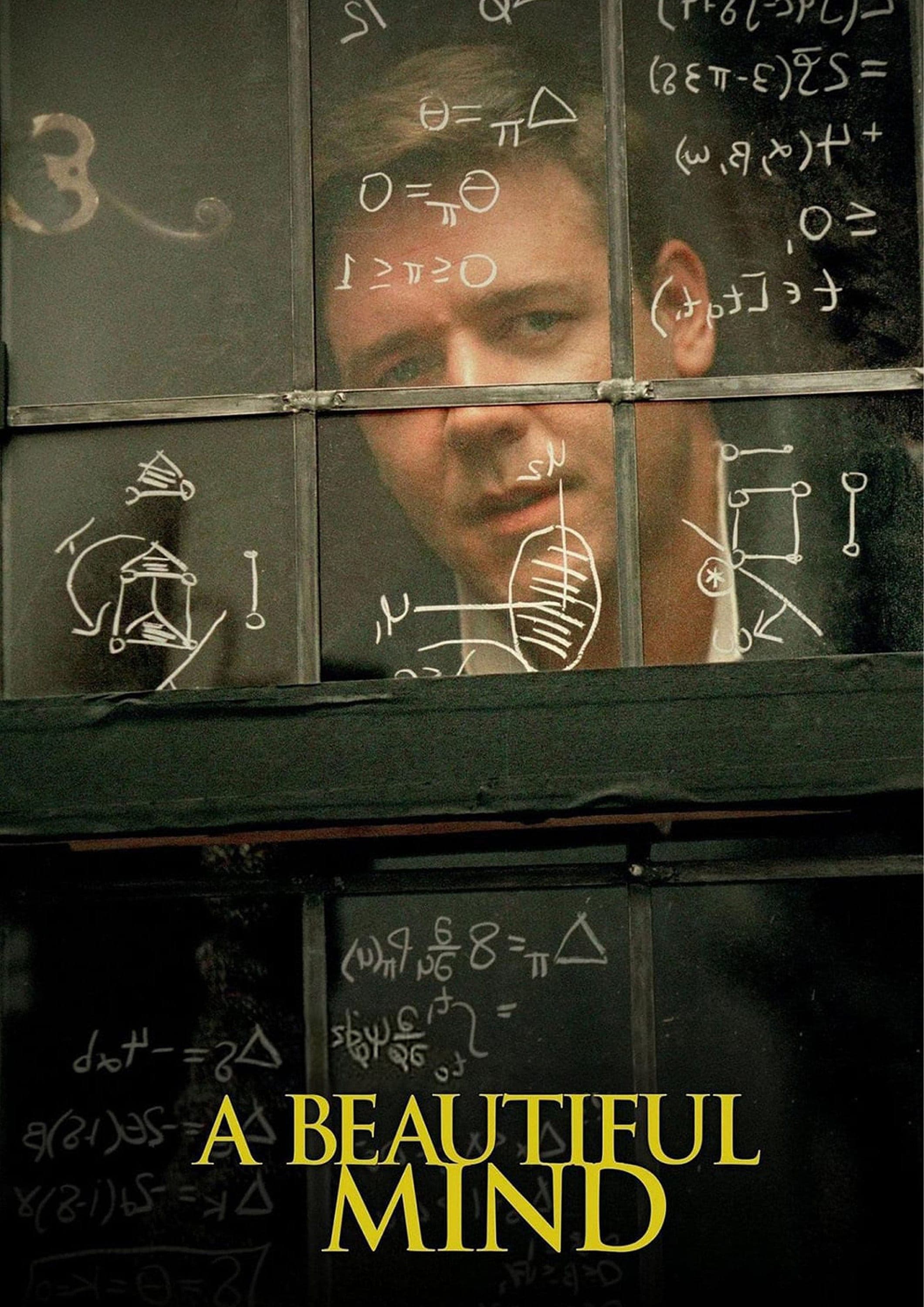
A Beautiful Mind
Genius, delusion and a marriage that refuses to give up — does Ron Howard’s biopic still move us?
Feature presentation
A Beautiful Mind is the sort of movie that arrives with a familiar knot: brilliance and madness braided together, a portrait of a man who wants one defining idea and pays for it in human currency. Ron Howard’s 2001 film gives us John Forbes Nash Jr. up close — the Mathieu-style obsessiveness, the social bluntness, and the way a mind can both invent new worlds and be invaded by them.
THE MOVIE
John Forbes Nash Jr. is still the reason this movie works
When the film starts, you’re with a young mathematician who wants a single idea that will make his name — not money, not comfort, but that clean slice of originality. That obsession propels everything that follows: academic ambition, earned enemies, and a loneliness that nudges him toward dangerous places.
Howard and Akiva Goldsman give us John Nash as a mixture of brilliance and brittle social awkwardness. The narrative follows his time at Princeton, the early work on game theory and then, crucially, the slow creep of paranoid delusions that complicate everything — career, family, friendship.
It’s a long, carefully made film: roughly two hours and fifteen minutes, with Russell Crowe in the central role and Jennifer Connelly playing the partner who keeps showing up. The movie deliberately blurs the line between what Nash invents and what he experiences, which is why it still invites conversation.
THE SETUP
The idea that sets A Beautiful Mind in motion
At its simplest: the film charts Nash’s promise as a mathematician, his contribution to game theory and the later intrusion of schizophrenia into his life. That basic arc is tidy enough for a drama — genius followed by crisis followed by a long struggle to live with the consequences.
What gives the setup its dramatic juice is the clash between two drives: Nash’s hunger for a defining, elegant idea and the disruptive, isolating effects of his psychiatric symptoms. The two are braided together so the story never feels like only a medical case history or only a career biopic.
Filmmaker’s trick: the screenplay turns large parts of Nash’s internal experience into what look like other people and events on screen. Presenting hallucinations as concrete characters puts the audience inside his perspective, which is a strong way to make subjective confusion cinematic.
That approach is also why the movie sometimes chooses clarity over literal history: the film compresses and reshapes episodes from Nash’s life to create a single dramatic through-line rather than a documentarian’s chronology.
THE CHARACTER
Why John Forbes Nash Jr. matters
John Nash isn’t memorable because he’s a genius in the abstract. He’s memorable because the film lets you feel the shape of that particular mind: a hunger for recognition, a taste for elegant solutions, and a bluntness that makes him difficult company.
The movie uses invented and composite figures to make those interior states visible. Characters who don’t correspond neatly to historical people act as stand-ins for his private world, so Nash becomes a character whose battles play out as much on a personal stage as on an intellectual one.
That choice tightens the drama. Rather than follow a neat, chronological biography, the film compresses decades of life into moments that reveal his obsession, isolation and the consequences of both.
And because the story centres on his relationships with peers, faculty and family, Nash is never simply an idea machine on screen — he’s someone whose social blindness and arrogance shape his fall and, eventually, his fragile return.
THE PERFORMANCE
Why Jennifer Connelly's performance matters
Jennifer Connelly’s role as Alicia functions as the film’s persistent human ballast. Contemporary coverage singled out her work and the movie’s awards season run confirmed that attention.
Her part matters because the story makes Alicia the person who keeps returning: she’s partner, caregiver and the one who negotiates the hush and the argument and the slow accommodations of living with a loved one in crisis.
That central placement in the drama is why recognition — including major awards attention for Connelly — felt appropriate to many viewers at the time.
Seen on its own terms in the film, Alicia is the stabilising force whose choices determine how Nash’s later chapter plays out.
UNDER THE SURFACE
A Beautiful Mind has more on its mind than the plot suggests
On the surface it’s a life story: early brilliance, career trouble, long recovery. Underneath, the film asks how we frame genius when it arrives with illness attached. That question quietly colours every interaction.
It is also a movie about perception. By showing hallucinations as people and events, the film asks us to live inside a mind that can’t be trusted — and then makes the audience complicit in that misdirection for the sake of empathy.
Marriage and caregiving are not mere backstory here. The partnership at the centre of the film is the practical route by which the protagonist remains present in the world. The film keeps returning to the small, stubborn decisions that make that possible.
And finally, beneath the drama is a tension between isolation and community. Nash’s gifts separate him; the story’s small redemption is that other people — colleagues, family — create enough tethering to allow a different kind of life.
THE FILMMAKING
How A Beautiful Mind was put together
A big part of the film’s personality comes from its visual and sonic decisions. Roger Deakins shot the picture, and the production uses shifts in film stock and colour treatment to mark changes in time and in Nash’s mental state.
That kind of craft keeps the audience oriented even when the story itself is deliberately disorienting. It’s a neat way to remind viewers they’re watching a constructed narrative while still letting them experience subjective confusion.
Location work in Princeton and other New Jersey and New York sites gives the film a tangible academic atmosphere. Those settings make the period detail feel lived-in rather than simply theatrical.
At the time, reviewers pointed to Howard’s direction and the movie’s production values as central strengths, even as some commentators questioned the choice to visualise hallucinations that were historically reported as largely auditory.
PRACTICAL EFFECTS
The effects work that gives A Beautiful Mind its physical personality
The film relies on hands-on techniques to show a life across decades. Make-up and age-progression were used to show Nash ageing, with production reports noting that some scenes were shot in continuity to support those practical methods.
But the movie doesn’t lean on spectacle. Instead it uses staging, performance and camera composition to make subjective hallucinations feel real; large mechanical or optical effects aren’t the point here.
That modest toolkit helps keep the story intimate. You’re watching behaviour and small changes rather than an effects-heavy pageant.
In short: the practical choices are quiet but purposeful, designed to keep the attention on people rather than tricks.
PURE 00s
A Beautiful Mind could not belong to any other decade
Coming at the end of 2001 and opening wide in early 2002, the film arrived squarely in the awards-season habit of prestige biopics. That calendar placement matters: these December releases were designed to be taken seriously by critics and awards voters.
It also fit neatly into a run of projects from studios and producers that were balancing commercial reach with awards ambition. This was the era when studios leaned into those kinds of prestige pictures as reputation-builders.
The film’s release timing and its production partnerships gave it the architecture of an early-2000s awards player — and that shaped how audiences and critics received it.
There was also a quick cultural response: the documentary A Brilliant Madness followed a year later to present the life in documentary form and to tease apart the film’s dramatisations from the historical record.
WATCHING IT NOW
What has aged — and what hasn't
The narrative spine — Nash at Princeton, the birth of his ideas, and the arrival of paranoid delusions — remains clear and emotionally compelling. That basic human story of talent, struggle and slow recovery still reads easily to a modern viewer.
Where the film shows its age is in how it reshapes the historical record for clarity. The screenplay invents or heavily fictionalises several characters and compresses events across decades to create a neat dramatic arc, which means the film is best taken as a spirited adaptation rather than a literal biography.
Those dramaturgical choices were deliberate: they make a complex life watchable in a single feature, but they also invite scrutiny in light of later, more documentary-minded accounts.
If you watch now, treat the movie as an emotional shorthand for Nash’s experience rather than an exact timeline. Both readings can be valid — they just answer different questions.
THE LEGACY
Why A Beautiful Mind still matters
Part of the film’s afterlife comes from its awards run: it brought home several major Oscars and was widely seen as a prestige win for its studios and makers. That visibility cemented its place in early-2000s film conversation.
The movie also widened public awareness of John Nash and pushed conversations about schizophrenia into mainstream spaces. For many viewers it was the first time they encountered that kind of psychiatric story in a mainstream film.
That visibility sparked pushback too: the film’s dramatic liberties prompted commentators to probe the ethics of adapting a real life and to promote documentary work that tells more of the historical detail.
So the legacy is double-edged. It’s remembered because it reached lots of people and because it asked difficult questions about the human costs of brilliance — and it remains part of the conversation precisely because the adaptation choices invite debate.
THE VERDICT
Does A Beautiful Mind still hold up?
Yes — with a couple of important caveats. If you want a tight, emotionally driven drama about a brilliant, difficult man and the partner who refuses to abandon him, this film still does that job well. It tells a clear story about ambition, delusion and the slow work of staying present.
But it’s not a literal history. The screenplay explicitly reshapes decades of life and invents characters to make Nash’s inner world visible on screen, which is a defensible dramatic choice but one that changes what the film claims to be.
So watch it as a powerful piece of storytelling rather than a documentary. The compressed arc — from breakthrough at Princeton through illness and on to late recognition — makes for satisfying cinema, even if the route is sometimes invented.
In short: A Beautiful Mind remains worth watching for its humane framing of a complicated life and for how it keeps the caregiving relationship at the film’s centre. It asks you to sit with a mind that both creates and betrays itself — and, more importantly, to notice who stays with it.
Share this movie
Keep watching
More movies from the 00s

2002
The Pianist
A quiet life unmade by war — and a pianist who refuses to stop listening.
Read the retrospective
→
2006
Blood Diamond
A mercenary, a fisherman and a pink diamond — and a film that still asks who pays for our jewellery.
Read the retrospective
→
2003
Kill Bill: Volume 1
A yellow jumpsuit, a long list of enemies and one woman who refuses to be finished.
Read the retrospective
→