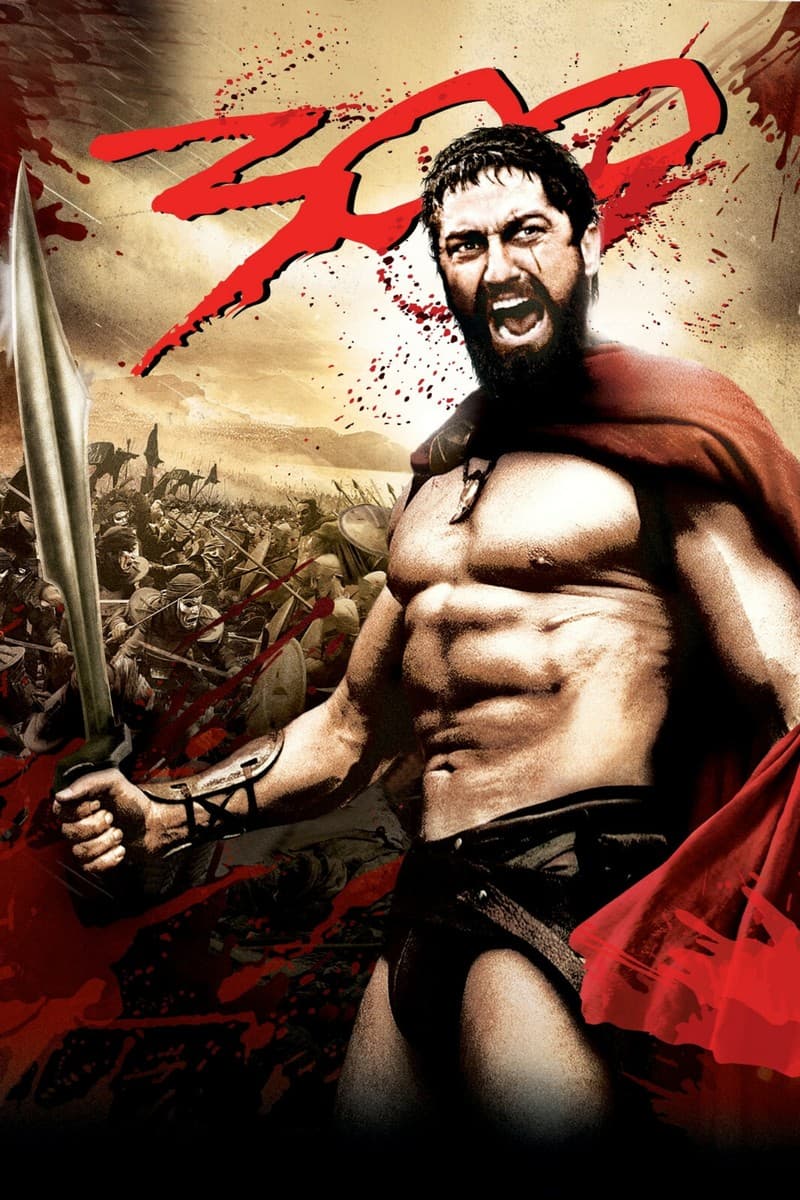
300
Big shields, bigger speeches — and a king who makes the whole thing feel like a legend told on purpose.
Feature presentation
If you remember 300 at all, you probably remember one man standing in slow motion and the rest of the movie building bravado around him. Zack Snyder’s adaptation turns the stand at Thermopylae into a puppet show of marble chests, blood-slick choreography and deliberate myth-making. Rewatching it now is less about history and more about how stories dress themselves up to be remembered.
THE MOVIE
King Leonidas is still the reason this movie works
300 stages one clear, show-stopping idea: a handful of Spartans led by King Leonidas hold a narrow pass against an enormous Persian host. That compressed battlefield gives every clash a headline quality — it’s theatre as much as tactics.
The movie tells itself as a story, too. Much of what we see is filtered through the voice and memory of a Spartan soldier, Dilios, which lets the film lean into fantasy and embellishment rather than pretending to be a documentary of Thermopylae.
At the centre of all that is Leonidas — the warrior-king whose code and choices keep the action honest. Put simply: 300 is built around him, and everything else exists to make his stand feel like legend.
THE SETUP
The idea that sets 300 in motion
The film’s premise is straightforward and ruthless: take a tiny, disciplined force and put them where numbers count for less. The narrow pass at Thermopylae isn’t a backdrop so much as a rule that shapes every decision and punch.
That restriction keeps stakes simple. When Leonidas sends his men forward, each advance reads like a deliberate choice against overwhelming odds, which makes bodies and banners mean more than they would in a sprawling fight scene.
Snyder’s screenplay also widens the frame with a home-front subplot — Queen Gorgo pushing Sparta’s council for support — which gives the film a political pulse that wasn’t identical in the comic book pages. It stops the movie being only about spears and makes it about duty and persuasion as well.
Framing the battle as a told tale lets the film admit its own artifice. It wants to be remembered, so it arranges its facts into a story worth remembering.
THE CHARACTER
Why King Leonidas matters
Leonidas is the film’s organising principle. Everything from the choreography of a shield wall to a close-up of a shout is arranged to make his choices feel consequential.
He isn’t an everyman or a tragic soul in subtle motion — he’s written and staged as Sparta’s warrior-king whose personal code sets the plot in motion. The movie gives him the space to be decisive, and the story reacts to him rather than the other way around.
Because the narrative wants to be mythic, Leonidas functions like a kernel you can build legend around: his defiance, his command and the decision to stand make him the obvious anchor for the film’s spectacle.
THE PERFORMANCE
Why Gerard Butler's performance matters
Contemporary coverage consistently pointed to Butler as the centre of the screen — he’s the named lead and the figure around whom the film arranges its bravado.
That centrality is practical as much as artistic: when a movie leans on myth-making, it needs a clear focal presence so the audience can follow what to admire. Butler’s placement in the cast list and the way scenes revolve around Leonidas provide that focus.
So the more useful way to think about the casting is this: the film depends on a single commanding on-screen figure, and Butler occupies that role, giving the story someone obvious to rally behind.
UNDER THE SURFACE
300 has more on its mind than the plot suggests
On the surface 300 is blood-and-shield spectacle; underneath it’s a film arranging events into a heroic pattern. Heroic sacrifice and martial valour aren’t accidental props — they’re the story’s currency.
The narration and the way scenes are composed turn real events into a saga. That’s the film indulging in myth-making: it dresses facts in ritual and gives small acts outsized meaning.
There’s also a deliberate preference for spectacle over strict historical accuracy. The movie trades a sober, complicated past for simplified, heightened moments that read cleanly on screen.
Finally, leadership and duty run through the whole thing. Whether on the battlefield or in Sparta’s council chambers, decisions are treated as obligations — and the drama comes from seeing who will shoulder them.
THE FILMMAKING
How 300 was put together
Visually, 300 presents itself as a live comic strip. Snyder planned many shots with Frank Miller’s panels in mind, and the camera framing often feels like a direct invitation to translate static composition into motion.
Larry Fong’s cinematography and the post-production image work pushed the film away from naturalism: the team deliberately crushed colours and boosted contrast to mimic the graphic novel’s stark palette.
A huge chunk of the movie was finished in post. Multiple visual-effects houses — including Montreal teams — stitched together plates and backgrounds for well over a thousand VFX shots, a process that took roughly a year to complete the film’s distinctive look.
The credits list is worth a glance because it shows this was a planned, collaborative build: the director and writers, a named production designer and an editor who all helped translate a comic-book sensibility into a feature film.
PRACTICAL EFFECTS
The effects work that gives 300 its physical personality
Beneath the digital sheen there’s a lot of actual craft: the production made hundreds of costumes and used extensive prosthetic makeups and staged dummy corpses so physical touches would read when composited into the finished frames.
Some sequences married real photography with CGI — practical smoke was used, and underwater tank shoots were employed to create ‘wet for dry’ moments (the Oracle sequence combined those elements with digital work).
Creature and character concepts were developed with established designers involved, and the finished visuals come from a pipeline that mixed practical photography with heavy compositing rather than relying on pure CGI alone.
That mix gives the film a tactile edge: even when the background is digital, there are physical props and makeup close to the actors to give scenes some weight.
PURE 00s
300 could not belong to any other decade
300 arrived at a moment when comic-book adaptations were experimenting with tone and audience: this wasn’t a family-friendly superhero film but an R-rated, adult-targeted comic adaptation that aimed to be both stylised and bruising.
It’s part of an early wave of mid-2000s graphic-novel films that foregrounded hyperreal visuals and leaned on digital backlot techniques to reproduce ink-and-panel imagery on screen — a sensibility shared by films from that period.
Released in 2007, it sat neatly in a studio agenda that was widening what comic adaptations could be, offering something more operatic and less bound to straightforward realism.
That commercial positioning — a mainstream, grown-up comic adaptation — is why the film reads so much like a product of its time: confident, glossy and deliberately theatrical.
THE LEGACY
Why 300 still matters
One obvious legacy is the film’s afterlife as a franchise: it spawned a follow-up in 2014 that expanded the same stylised battlefield world.
More quietly, the movie’s visual approach helped shape Zack Snyder’s career path; studios took notice of what a signature, graphic-novel aesthetic could look like when translated to the big screen.
But 300 also sparked real debate. Its depiction of Persians and the way it compresses history into myth provoked international discussion and formal complaints from cultural bodies and diplomatic channels — a reminder that myth-making on a large canvas rarely stays purely aesthetic.
Taken together, these elements explain why the film remains in the conversation: it’s remembered for its swagger, its cinematic look and the conversations it forced about representation.
THE VERDICT
Does 300 still hold up?
If you come for history, leave disappointed. 300 is a retelling dressed up as myth: it foregrounds a narrated tale about Leonidas and his 300 holding a pass rather than attempting faithful reportage of 480 BC.
But if you come for a very specific kind of cinematic spectacle — stylised combat, a tightened battleground and a story that treats sacrifice like an almost performative honour — the film still delivers. The narrowed battlefield and the decision to stage the action as legend make the stakes immediate and readable.
The screenplay’s addition of a political strand at home (Queen Gorgo pushing Sparta’s council) helps the movie avoid being single-note: it balances spear clashes with a reminder that war is shaped by persuasion and duty as much as by muscle.
So should you watch it? Yes, if you accept its terms. Watch 300 as a worked-up epic poem about leadership and sacrifice, fronted by Leonidas as its centrepiece. Taken on those terms, it still knows exactly what it wants to be.
Share this movie
Keep watching
More movies from the 00s

2002
The Pianist
A quiet life unmade by war — and a pianist who refuses to stop listening.
Read the retrospective
→
2006
Blood Diamond
A mercenary, a fisherman and a pink diamond — and a film that still asks who pays for our jewellery.
Read the retrospective
→
2003
Kill Bill: Volume 1
A yellow jumpsuit, a long list of enemies and one woman who refuses to be finished.
Read the retrospective
→