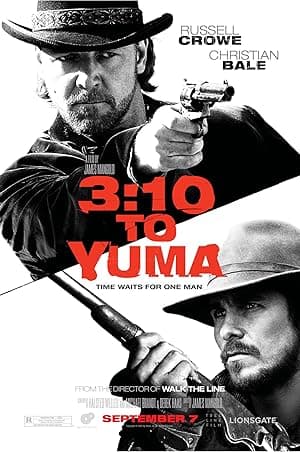
3:10 to Yuma
A duel of honour and choices — and Ben Wade makes the match worth watching.
Feature presentation
You don't watch 3:10 to Yuma just for a shoot‑out. You watch it to see what happens when a desperate man takes on a charming outlaw and finds himself tested in ways cash can't fix. James Mangold remade Elmore Leonard's story into a late‑2000s Western that keeps nudging at questions of honour, family and what it means to do the right thing.
THE MOVIE
Ben Wade is still the reason this movie works
If you remember one thing from 3:10 to Yuma it isn't the train timetable — it's Ben Wade. Russell Crowe's outlaw sits at the film's centre, a luminous complication who makes a plain escort job feel like a moral experiment.
James Mangold's 2007 remake lifts the bones of Elmore Leonard's short story and rebuilds them as a Western that keeps tugging at why men do dangerous things for honour as much as for money. Christian Bale plays the rancher who volunteers to take Wade to the 3:10 train to Yuma, and that premise—practical at first—quickly becomes a character test.
Over 122 minutes the film frames redemption, father‑son loyalty and the blurry line between law and outlaw as practical dilemmas you can almost weigh in your pocket. It's a Western that asks you to watch people make choices.
THE SETUP
The idea that sets 3:10 to Yuma in motion
At its simplest, the movie asks a neat, old‑school question: what happens when a man with everything to lose takes on the job nobody else wants? Dan Evans, a drought‑hit Civil War veteran and rancher, volunteers to escort captured outlaw Ben Wade to a scheduled 3:10 train bound for Yuma in exchange for money.
That exchange—cash for custody—gives the plot its framework, but the film makes sure the journey isn't just procedural. A railroad agent hires a reluctant posse, and the trip repeatedly runs into the business end of Wade's gang. Ambushes, pursuits and small‑scale violence keep turning a practical errand into an escalating ordeal.
Crucially, the setup is designed so every skirmish is also a test: Evans' resolve, pride and ability to keep Wade alive are probed again and again. The train departure becomes a countdown that converts external danger into an internal measure of who Dan is willing to be.
As a remake of the 1957 picture, the 2007 film keeps that central premise—one man escorting another to the train—but reworks the mechanics for a modern, star‑led Western audience.
THE CHARACTER
Why Ben Wade matters
Ben Wade isn't a flat baddie. The film presents him as a charismatic, amoral outlaw whose intelligence and charm continually muddy the simple good‑guy/bad‑guy divide.
Because the drama hinges on a man taking custody of Wade, the outlaw functions less like a target and more like a mirror: his presence forces other characters, especially Dan Evans, into decisions that reveal who they are.
Russell Crowe occupies that role at the centre of the picture, and the way the story is constructed means Wade's personality ripples through every scene he touches. He's the reason accusations and bargains feel personal rather than generic.
Put simply: the movie gives you a villain who is interesting to talk to, and that alone makes the whole business of getting him onto a train feel like a high‑stakes conversation.
THE PERFORMANCE
Why Russell Crowe's performance matters
One dependable fact: the cast is led by Russell Crowe as Ben Wade and Christian Bale as Dan Evans. That headline pairing is part of how the film is sold and how it reads on screen.
Because the script gives Wade a particular kind of charm and menace, casting a recognisable star in the role makes the character feel central by design. The movie leans on that clarity: you know who to watch when a room goes quiet.
Mentioning the lead isn't a review of technique so much as recognition of structure. The film builds its moral tension around the two leads sharing space, and Crowe's billing signals that Wade will be the force those choices keep returning to.
In short: the performance credit is an element of the storytelling. The part is written to be watched, and the casting reflects that.
UNDER THE SURFACE
3:10 to Yuma has more on its mind than the plot suggests
Beneath the train timetable are themes the movie keeps coming back to: redemption and moral testing. The escort isn't just a job; it's a chance to prove or redeem oneself.
There is also a steady interest in honour and moral choice. The film sets up situations where the 'right' action isn't the one that will get you paid or keep you safe immediately, and it forces characters into decisions that matter to their self‑respect.
Family and the father‑son relationship are threaded through the story too. Dan's choices have personal consequences that ripple through his household, making the stakes domestic as well as civic.
Finally, the film enjoys sitting on the line between law and outlaw. It keeps asking when throwing someone on a train is justice and when it becomes a spectacle—so the audience ends up judging both outlaw and the man who escorts him.
THE FILMMAKING
How 3:10 to Yuma was put together
Several dependable crew names sit behind the screen: Phedon Papamichael handled the cinematography, Michael McCusker edited the picture and Marco Beltrami supplied the score. Those collaborators give the film a consistent technical backbone.
James Mangold steers the project as director, and the combined work of cinematography, editing and music is the frame the story uses to time its moral beats and action sequences.
It matters because a countdown‑style story needs a reliable tempo. Good cutting, clear photography and a score that supports tension are the nuts and bolts that keep a Western's small moments from sagging.
So while the plot is about choices, the film's assembly is what makes those choices feel tense rather than incidental.
PRACTICAL EFFECTS
The effects work that gives 3:10 to Yuma its physical personality
A lot of the movie's personality comes from doing things the old way: the production staged stagecoach and cavalry action sequences with mounted riders and practical stunts on location.
Those on‑the‑ground setpieces keep the action feeling physical and immediate. When a coach is run down or a pursuit unfolds, you can sense the mechanics of horses and riders rather than a purely constructed image.
There are also smaller, tangible props that carry weight. Production notes and publicity materials mention a working antique pistol nicknamed the 'Hand of God' associated with Ben Wade — the kind of object that gives a scene a particular texture.
All of this adds up to a Western that prefers the tactile: people on horses, a real coach, a real pistol. It helps the film feel like a thing you could reach out and touch.
PURE 00s
3:10 to Yuma could not belong to any other decade
The 2000s had a curious appetite for bringing serious Westerns back into mainstream cinema, and 3:10 to Yuma sits squarely in that moment. James Mangold made the film after his commercial success with Walk the Line, and the timing left room for a star‑led revisit of the genre.
Its financing and distribution — Relativity Media producing and Lionsgate handling North American release — reflects the mid‑2000s model of independent financiers partnering with studio distributors to get mid‑budget films into cinemas.
The picture was shot in New Mexico and premiered in late August 2007 before opening more widely in September. That schedule and production approach feel very 2000s: location work combined with a clear theatrical rollout.
So while the story borrows from the 1950s original, the way the movie was made and released places it firmly in the late‑2000s film ecosystem.
THE LEGACY
Why 3:10 to Yuma still matters
Part of the film's afterlife comes from being an explicit remake: it's constantly discussed beside the 1957 Delmer Daves picture because they share source material and the same central premise.
It also had a practical effect on the marketplace: the movie opened at number one in the U.S. and helped sustain a modest commercial revival of studio‑backed Westerns in that late‑2000s window.
So its legacy is twofold — a conversation with an older film and a small, real contribution to a brief era when studios were willing to back serious Westerns again.
Those are tidy, concrete reasons to remember it: not myth‑making, just the ways a well‑timed remake can keep an old story alive and push a genre back into the conversation.
THE VERDICT
Does 3:10 to Yuma still hold up?
Yes — but with a useful rider. If you want a Western that stages moral choices as a kind of ticking clock, this one still delivers. The film's premise is simple and solid: Dan Evans, a drought‑struck rancher, volunteers to escort the captured outlaw Ben Wade to the 3:10 train to Yuma, and the week‑long journey becomes a test of resolve.
That structural clarity—ambushes, a paid posse, pursuit by Wade's gang and a persistent countdown to a scheduled train—keeps tension honest. The drama belongs to choices made under pressure, and the story keeps those pressures coming until the train is literally on the horizon.
Another practical reason to watch is the casting; Russell Crowe as Ben Wade and Christian Bale as Dan Evans are the pair the film is built around, and contemporary critics repeatedly singled out their work (along with notable support like Ben Foster and Peter Fonda) as major strengths.
So if you enjoy Westerns that make violence and honour feel like decisions rather than spectacle, and you like a story that tightens into moral and familial stakes, 3:10 to Yuma is still worth your time. It doesn't pretend to rewrite the genre — it sharpens a classic question until you can see the edges.
Share this movie
Keep watching
More movies from the 00s
2002
The Pianist
A quiet life unmade by war — and a pianist who refuses to stop listening.
Read the retrospective
→
2006
Blood Diamond
A mercenary, a fisherman and a pink diamond — and a film that still asks who pays for our jewellery.
Read the retrospective
→
2003
Kill Bill: Volume 1
A yellow jumpsuit, a long list of enemies and one woman who refuses to be finished.
Read the retrospective
→