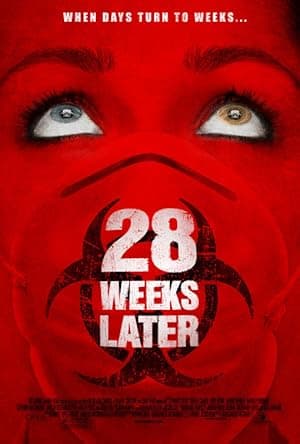
28 Weeks Later
Military order, family mess — London is secured until someone brings home the wrong thing.
Feature presentation
Think of 28 Weeks Later as a tidy experiment that refuses to stay tidy. Juan Carlos Fresnadillo moves the Rage Virus story from grim survival into a militarised clean-up operation — and then lets families and human mistakes do what armies cannot. It's a short, sharp disaster movie with a very specific engine: people trying to undo catastrophe while carrying the seeds of a new one.
THE MOVIE
Don is still the reason this movie works
There’s a clean, almost clinical premise at the film’s core: six months after the Rage Virus emptied London, a U.S.-led military presence tries to repopulate a quarantined district and make a sensible life possible again. That practical, post-crisis arrangement gives the sequel a different beat to the first film — the emergency has become an administration problem.
Into that bureaucratic order walks Don, a father carrying a decision from his past that keeps pulling him off-script. His choices bend the story’s moral geometry; family in 28 Weeks Later isn’t just emotional ballast, it’s the biological and ethical vector that does the real damage.
That collision — disciplined containment vs private responsibility — is what still makes this film worth revisiting. Under Juan Carlos Fresnadillo’s direction, the movie keeps its tempo tight: ninety-nine minutes of policy and regret, until one small human arrival undoes what armies tried to secure.
THE SETUP
The idea that sets 28 Weeks Later in motion
Rather than pick up as another small-group survival story, 28 Weeks Later assumes the virus has been pushed back and asks what happens next: a U.S.-led effort to repopulate a quarantined bit of London becomes the film’s operating premise.
That makes the central tension three-way: the infected as an outside threat, civilians trying to rebuild domestic life, and military forces who are meant to keep everyone safe. The drama comes from those forces rubbing together, not from a lone protagonist against the mob.
The film keeps drawing the contrast between the protocols meant to keep the virus contained and the messy human choices that break those rules. It’s less about whether the plan exists and more about whether people can — or will — follow it.
And because an arriving group of evacuees includes a child who functions narratively as an asymptomatic or potentially immune carrier, the set-up carries its own ticking alarm: what looks like a hopeful repopulation becomes the spark for another outbreak.
THE CHARACTER
Why Don matters
Don is not just another dad in danger; he’s the emotional hinge that makes the military plot unbearable. The film deliberately ties his past decision to the choices he makes during the repopulation, so his private story changes the stakes for everyone.
Because the movie treats family as both a source of hope and a vector for catastrophe, Don’s role is structural: his guilt and responsibility turn a public containment programme into a personal mission. That’s why the big set-pieces land as moral as well as physical crises.
Mentioning Robert Carlyle is only part of it — Don matters because the film keeps coming back to him whenever the situation starts to feel abstract. He drags the consequences of policy down into real human terms.
And that focus explains the film’s rhythm: tight, forward-moving scenes punctuated by sudden, intimate reckonings centred on one man’s attempt to fix what he helped break.
THE PERFORMANCE
Why Robert Carlyle's performance matters
A useful shorthand for the film’s opening is this: several reviewers singled out Carlyle’s early scenes as the emotional anchor. That’s not marketing puff — it’s the specific way the movie steadies itself.
Those opening beats give the audience something human to hold onto before the action expands back out. The effect is practical: an occupied city, a secure zone, army logistics — all of it feels urgent because the film keeps returning to a man with a private cost to carry.
So when protocol starts to unravel later, the fallout feels personal rather than schematic. The audience’s understanding of the stakes is already rooted in the scenes we were invited to care about first.
Put simply: whatever else the movie is doing, those early moments do the heavy lifting of making us believe in Don’s decisions — and therefore in the story’s worst reckonings.
UNDER THE SURFACE
28 Weeks Later has more on its mind than the plot suggests
On the surface this is a zombie/science-fiction/horror ride — but beneath that surface it’s quietly obsessed with how societies try to tidy up after catastrophe. The movie is interested in the fragility of reconstruction and how a militarised containment can look decisive while harbouring practical and ethical weaknesses.
Family is not decorative here. It’s a narrative tool and a thematic problem: the film uses households and parental duty as legitimate engines for both compassion and catastrophe. That dual role keeps the drama tight and morally uncomfortable.
There’s also a steady contrast between rules and mistakes. Protocols exist to stop the virus, but human error — individual choices made under pressure — repeatedly allows the contagion back in. That tension is the movie’s recurring note.
All of this folds into a particular worry about what happens when the job of saving people becomes someone else’s remit: armies can secure streets, but they can’t always secure the private calculus that makes people risk everything for family.
THE FILMMAKING
How 28 Weeks Later was put together
The director pushes for immediacy. Fresnadillo keeps the camera restless and the edit quick, a visual strategy reviewers often likened to documentary-like sprinting — the aim being to make every moment feel urgent and unplanned.
credit also belongs to Enrique Chediak, the director of photography, whose tight handheld framing underpins that sense of breathless movement. The film doesn’t let you settle; it wants you close to the action and, just as importantly, close to the people caught in it.
Those choices serve the story: a militarised, administrative setup could have become cold and distant, but the filmmaking argues for proximity instead. When procedures collapse, we feel it not as an abstract failure but as a messy, immediate catastrophe.
Production credits such as editor Chris Gill and production designer Mark Tildesley help glue that approach together: brisk cutting and thoughtful set-work keep the film efficient and propulsive across its ninety-nine-minute runtime.
PRACTICAL EFFECTS
The effects work that gives 28 Weeks Later its physical personality
The infected are made convincing in a deliberately physical way: makeup and contact lenses were used to transform performers, with actors spending extended periods in prosthetic and eye-lens makeup for infected scenes.
That tangible approach helps the film feel bodily and immediate — the horror is not just conceptual but viscerally present on faces and in eyes.
The production also used movement workshops and a movement specialist to establish consistent physical behaviour across infected performers. That shared physical vocabulary sells the idea of a communal, frenzy-driven infection.
Combined, those practical steps keep the threat recognisable and repeatable: when the infected move and look alike, the film’s world feels coherently dangerous rather than haphazard.
PURE 00s
28 Weeks Later could not belong to any other decade
Arriving in 2007 as the canonical follow-up to a 2002 landmark, the film sits squarely inside the 2000s preoccupation with viral outbreak stories that doubled as reflections on occupation, security and post-9/11 geopolitics. It’s a genre picture with an eye on contemporary anxieties.
Where the original favoured intimate survival horror, the sequel scales up into a mid-2000s tendency for larger, militarised disaster narratives. That shift from small to institutional changes the film’s questions — how do you police recovery, and who gets to decide which lives are worth saving?
Its production timeline — principal photography in 2006 and a 2007 release — places it in the middle of that conversation. The film reads like a product of its moment because it trades the claustrophobic for the administrative while keeping the stakes personal.
So yes, it’s of the 00s, but in the useful sense: its anxieties and its scale reflect the era’s cinema without relying on cheap nostalgia for spectacle.
THE LEGACY
Why 28 Weeks Later still matters
The film occupies a clear place in the franchise as the official follow-up to 28 Days Later, and it was widely discussed on release as a story that extended the Rage Virus premise rather than repeating it.
Its opening sequence in particular has kept returning in retrospective coverage as one of the franchise’s most effective set pieces — a compact blunt instrument that establishes stakes and tone with economy.
Beyond that, later franchise developments revisited and recontextualised elements the sequel introduced, which is a tidy way of saying the movie left threads the series felt worth pulling on later.
So its longevity is practical: it widened the franchise’s questions about containment and family, and those ideas kept feeding later conversations within the series.
THE VERDICT
Does 28 Weeks Later still hold up?
Yes — but with a clear condition. The film’s power comes less from inventing new zombie tricks and more from how it stages failure: a supposedly secure District One, a U.S.-led military presence, and a repopulation plan that looks sensible until an asymptomatic arrival undoes it. That concept still lands.
What keeps the movie together is Don’s story and the way the film consistently contrasts rules with human choices. Robert Carlyle’s early scenes were singled out on release for giving the opening a steady emotional base, and that steadiness is precisely what lets the later collapse feel humiliating rather than merely exciting.
If you want a tight, idea-driven horror-thriller about reconstruction, responsibility and the human mistakes that unravel protocol, this still does the job. It’s ninety-nine minutes of tidy systems being exposed as fragile by very ordinary loyalties and errors.
So watch it for the moral friction as much as the scares. 28 Weeks Later doesn’t just show you a city in crisis — it keeps asking who should be trusted to fix it, and what happens when trust is given for reasons that are heartbreakingly personal.
Share this movie
Keep watching
More movies from the 00s

2002
The Pianist
A quiet life unmade by war — and a pianist who refuses to stop listening.
Read the retrospective
→
2006
Blood Diamond
A mercenary, a fisherman and a pink diamond — and a film that still asks who pays for our jewellery.
Read the retrospective
→
2003
Kill Bill: Volume 1
A yellow jumpsuit, a long list of enemies and one woman who refuses to be finished.
Read the retrospective
→