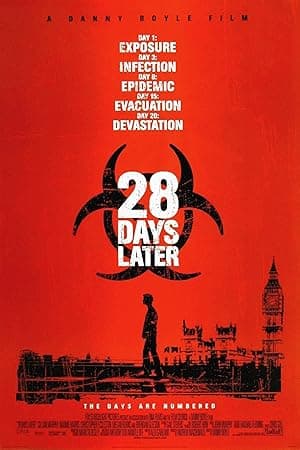
28 Days Later
A man wakes up to an empty London, and the question becomes how to stay human when everything else has fallen away.
Feature presentation
There’s a simple mechanism at the heart of 28 Days Later that keeps it tense and alive: Jim wakes up, and so do we. Danny Boyle’s 2002 thriller drops an ordinary courier into an extraordinary, abandoned Britain and watches what happens when the rules disappear — to chilling effect.
THE MOVIE
Jim is still the reason this movie works
You remember the empty streets first — London like a stage set with no audience. But the film only works because someone walks into that silence. Jim, a bicycle courier, wakes from a coma twenty-eight days after a contagion has swept the UK and finds a city that’s been emptied of ordinary life.
That jolting premise starts with a fairly simple, believable action: animal-liberation activists accidentally free infected creatures from a lab and the aggression-inducing 'Rage' virus leaps out. From there Danny Boyle steers a tight, suspenseful run that is stubbornly interested in how normal people respond when civic order collapses.
Which is why Jim matters. He’s not a specialised survivor or a secret hero — he’s the everyman dropped into an extreme situation and forced to learn to act. Around him the film builds its moral tests: who to trust, what to salvage, and whether safety can ever justify anything.
THE SETUP
The idea that sets 28 Days Later in motion
The film’s engine is compact and ruthless: a previously contained pathogen becomes loose after activists break into a research facility, and the aggression-triggering 'Rage' virus spreads fast. Boyle and Alex Garland don’t clog that idea with needless complication — the outbreak is a clear domino that everyone in the story must respond to.
Jim’s immediate objective is straightforward: stay alive and find other people. That practical aim — move, feed, shelter, don’t get infected — is the spine of the story, and most scenes exist to test the group’s small, brittle routines.
What keeps the second half from becoming a repeat of chased sequences is the human wrinkle. The survivors are eventually offered protection by a military unit under Major Henry West, and suddenly the threat isn’t only the infected outside the walls but the choices made by people inside them.
Framing the timeline around 'twenty-eight days' gives the film a neat, relentless architecture: this is the immediate aftermath, when everything has been disrupted but new orders and bargains are still being written.
THE CHARACTER
Why Jim matters
Jim is memorable because he’s the audience’s place to stand. He’s introduced as an ordinary bicycle courier who has no prep for apocalypse, which means we learn the rules of the ruined world with him rather than being told them from on high.
That ordinariness is not the same as blandness. The story asks Jim to make decisions that slowly shape him — to move from sheer bewilderment toward action and judgement. The film is more interested in those choices than in clean heroic beats.
Selena operates as a counterpoint: pragmatic, wary, and already schooled in survival realism. Her presence frames Jim’s learning curve — she’s the experienced hand he must reckon with when the film tightens its ethical screws.
Put simply: Jim matters because the film refuses to turn catastrophe into spectacle alone. It keeps returning to what a normal person does when the nets that once held society break.
THE PERFORMANCE
Why Cillian Murphy's performance matters
We can’t measure every nuance of a performance here, but there is a concrete industry note worth passing on: Christopher Nolan later said Murphy’s work in this film influenced his decision to cast him in Batman Begins. That’s a tidy piece of evidence that Murphy’s portrayal registered beyond this picture.
In practical terms the film needed someone who could plausibly be a courier one minute and an ethical actor under extreme stress the next. The movie’s structure depends on that plausibility — if Jim felt manufactured, much of the moral questioning would fall flat.
So the takeaway is modest but clear: Murphy’s Jim provides the credibility the script demands, the kind of grounded presence that lets the story’s stakes feel real rather than merely staged.
UNDER THE SURFACE
28 Days Later has more on its mind than the plot suggests
Beneath the chase scenes and the empty streets, the film keeps circling one practical question: what happens to ordinary rules when institutions vanish? The collapse of civic order isn’t merely backdrop — it’s the point of pressure that reveals character.
That pressure produces difficult, often ambiguous survival ethics. With no reliable law, characters must decide whether survival justifies harsh choices. The film poses those questions without offering pat answers, which is why the moral friction feels convincing.
There’s a second current here about authority. The military presence led by Major West isn’t just another refuge; it shows how the language of security can be used to justify coercion and darker bargains. The movie deliberately places human agency alongside the biological threat.
Finally, contagion and panic function on two levels: as a literal virus driving physical danger, and as a cultural condition that spreads fear and rewrites social behaviour. Layer on the startling imagery of empty cities and you have a film that uses spectacle to underscore social fragility.
THE FILMMAKING
How 28 Days Later was put together
A big part of the film’s personality comes from how it was made. The production leaned heavily on digital video and light, mobile cameras so the crew could shoot real, emptied streets at dawn — a practical way to get large-scale visuals without a blockbuster budget.
That approach gives the movie a kind of nervous immediacy: the camera can move quickly, get close to characters, and take advantage of real locations that feel recognisably lived-in even when they’re empty.
Using those lightweight methods on a modest budget isn’t just thrift; it shaped the film’s energy and helped sell the idea of a suddenly depopulated city.
So when you feel the film’s tempo — its sudden bursts and quieter, unhurried moments — some of that is directly tied to the production choices that allowed Boyle to be fleet and flexible on the streets.
PRACTICAL EFFECTS
The effects work that gives 28 Days Later its physical personality
One deliberate choice shapes the film’s sense of danger: infected people are presented as fast-moving, physically aggressive figures rather than the slow undead of older zombie tales.
That threat is largely performance-driven — the film treats the infected as immediate, stalking hazards, which changes the rhythm of every encounter and forces characters to react more urgently.
Because the menace reads as bodily and urgent, it keeps scenes lean and kinetic. You aren’t watching the lumbering approach of something already dead; you’re watching the sudden eruption of violence from something recognisably human.
That decision to emphasise speed and aggression is a core part of the movie’s personality; it makes danger feel sudden and personal, not ritualised.
PURE 00s
28 Days Later could not belong to any other decade
The film sits very much in the early-2000s moment because of how it married modest means to technological opportunity. Made for a relatively small budget, it exploited emerging digital cinematography to make big, empty-city set pieces possible.
That practical, do-more-with-less attitude is part of the decade’s filmmaking story: new tools changed what independent productions could show without studio money.
Beyond production, the film’s imagery — sudden societal collapse and vacant urban spaces — tapped into early-2000s anxieties in a way that resonated on release. That resonance helps explain why the movie kept being discussed in the years that followed.
Finally, the film’s emphasis on quicker, more kinetic infected antagonists helped kick-start a wider revival of infection-led stories in the decade that followed, shifting some genre expectations about how a virus-based threat should move and feel.
THE LEGACY
Why 28 Days Later still matters
There’s a practical piece of legacy here: the film is widely credited with giving new life to infection- and zombie-themed cinema in the 2000s, in part by showing that infected antagonists could be fast, aggressive and immediate.
It also produced a direct sequel in 2007 and further franchise developments afterward, so its narrative world didn’t just stop once the credits rolled.
And the film still shows up in lists and discussions about notable 21st-century horror and early digital filmmaking for genre cinema — partly because its empty-city images and production choices were unusually visible examples of what could be achieved on modest budgets.
In short, its afterlife is less about a single neat influence and more about the ways it nudged genre habits and filmmaking technique in the decade that followed.
THE VERDICT
Does 28 Days Later still hold up?
Yes — mainly because the film keeps the human through-line tight and clear. Jim’s waking and his immediate objective — to survive and find other people — gives the movie a straightforward moral engine that still engages.
That engine is what allows the film’s choices to land: the Rage virus supplies physical urgency, but it’s the arrival of the military and the ethical compromises offered inside that make the story stay with you. The film deliberately balances biological threat and human danger.
Add in the production pragmatism — lightweight digital shooting that let Boyle show empty London convincingly on a modest budget — and you have a film that still feels urgent rather than dated.
If you haven’t seen it, watch it for the way a simple premise is stretched into a series of moral tests. If you have, it’s worth a rewatch for the small, uncomfortable decisions the characters are forced into — the running infected and the empty streets are striking, but it’s the moments where Jim must choose that end up sticking around.
Share this movie
Keep watching
More movies from the 00s

2002
The Pianist
A quiet life unmade by war — and a pianist who refuses to stop listening.
Read the retrospective
→
2006
Blood Diamond
A mercenary, a fisherman and a pink diamond — and a film that still asks who pays for our jewellery.
Read the retrospective
→
2003
Kill Bill: Volume 1
A yellow jumpsuit, a long list of enemies and one woman who refuses to be finished.
Read the retrospective
→