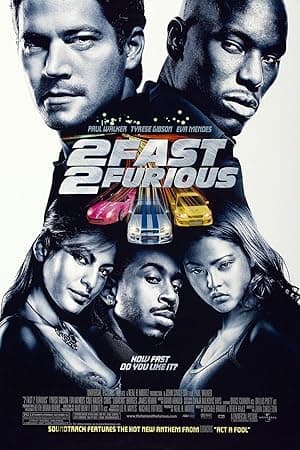
2 Fast 2 Furious
Fast cars, dodgy loyalties and one man trying to buy his freedom back — with a mate who won't let him off the hook.
Feature presentation
If you remember 2 Fast 2 Furious at all, you probably remember two things first: Brian O'Conner in a new city, and Roman Pearce loudly refusing to be placated. It's a sequel that switches tone and personnel from the original, and its heart is less about territory and more about two guys trying to sort out old scores while pretending everything's casual. Revisit it and you find a compact, slightly daft action picture that owes most of its charm to character friction rather than plot cleverness.
THE MOVIE
Brian O'Conner is still the reason this movie works
2 Fast 2 Furious drops Brian O'Conner into Miami as a onetime cop-turned-fugitive who has to play a very specific sort of double game: drive for a drug kingpin while secretly helping the authorities bring him down. That tension — the glittery ease of racing used as a cover for something morally messy — is the film's motor.
What gives the film personality isn't just the cars or the stunts but the way Brian's arrangement forces him back into people he once mattered to. Roman Pearce, an ex-con and childhood friend, arrives carrying old wounds and loud mistrust; their verbal sparring keeps the film animated when plot mechanics slow down.
John Singleton directs a picture that runs briskly (about 107 minutes) and leans into action, crime and thriller beats. Released in 2003, it deliberately reshuffles the first film’s pieces — new city, new faces, same central figure — and that choice makes Brian the glue holding the sequel together.
THE SETUP
The idea that sets 2 Fast 2 Furious in motion
At its simplest the film is an undercover sting: Brian is asked to move 'dirty money' for a local kingpin so federal agents can get close and take the organisation down. That premise keeps the stakes immediate — every race is cover, every meeting a potential betrayal.
Rather than unfold as a single procedural, the movie stitches together street-racing sequences and heist-style turns. The races put the characters in public performance, which is exactly the point: the spectacle creates access to Verone’s world.
Because this sequel was made without several original collaborators, it was conceived as a standalone continuation; the filmmakers even released a short film to bridge the gap from the first picture. That gives 2 Fast 2 Furious a feel of reinvention — same lead, different route.
The setup works because it trades mystery for momentum. You don't watch this one to untangle a detective story so much as to see how loyalties hold up when law and crime ask the same man to pick a side.
THE CHARACTER
Why Brian O'Conner matters
Brian is the pivot between two worlds: a former LAPD man who now walks as a fugitive, using his driving skill to survive and to negotiate his future with federal authorities. That tension — competence matched with vulnerability — is what the story keeps returning to.
He isn't a blank action archetype. The film positions Brian as someone trying to buy himself a second chance, and the choices he makes about who to trust drive the emotional beats more than any single chase sequence.
Crucially, Brian's chemistry with the people around him anchors scenes that could otherwise be pure noise. His history with Roman in particular turns simple exchanges into charged moments, because Roman's resentment colours everything they say to each other.
Seen that way, Brian matters because he makes the movie plausible: a man with enough skill to be useful and enough debt to the past to make the undercover work into something risky and interesting.
THE PERFORMANCE
Why Paul Walker's performance matters
When critics and retrospectives look back at 2 Fast 2 Furious they often point to the pairing of Paul Walker and Tyrese Gibson as a surprise strength. Their on-screen rapport turns what could be exposition-heavy scenes into banter that feels lived-in.
That chemistry makes the undercover stakes read as personal. The humour and friction between the two men turn moments of mistrust into something watchable, even when the plot moves in predictable directions.
So the performance value here is less about single show-stealing moments and more about a steady, relational rhythm: Walker's Brian is the calm axis to which the film attaches its louder impulses.
Put simply: the casting choice and the way the leads play off each other give the movie a heartbeat it otherwise might have lacked.
UNDER THE SURFACE
2 Fast 2 Furious has more on its mind than the plot suggests
Beneath the shifting paint jobs and staged races, the film is preoccupied with friendship and loyalty — how those things bend when past betrayal meets present danger. Brian and Roman's relationship forces the movie to ask what you owe a friend who once felt abandoned.
Redemption plays through Brian's choices. He's not merely completing missions; he's trying to secure a future that undoes earlier mistakes. That gives otherwise disposable set-pieces a purpose beyond spectacle.
The undercover premise introduces moral ambiguity: performing loyalty to a criminal organisation while actually working for the law is messy. Trust becomes transactional, and the film enjoys watching the balance wobble.
Finally, the racing scenes and public contests are about competition and masculinity — showing, in loud and obvious ways, how status is won and displayed within this subculture.
PRACTICAL EFFECTS
The effects work that gives 2 Fast 2 Furious its physical personality
A lot of the movie’s physical energy comes from properly staged driving work. Production relied on professional stunt drivers alongside local racers and modified cars so sequences felt immediate and could be executed safely.
When cars collide, those moments were managed with rigged vehicles and purpose-built stunt rigs to create controlled impacts rather than risky, uncontrolled crashes. The result is action that looks punishing without actually being reckless on set.
Larger, higher-risk beats were sometimes constructed from separate elements and composited in post-production. The filmmakers mixed practical stunts with post work to build bigger action moments than could be achieved in a single take.
All told, the picture leans on traditional stuntcraft as much as on post-production tricks — a practical approach that keeps many of the set-pieces feeling physical and grounded.
PURE 00s
2 Fast 2 Furious could not belong to any other decade
This is an early-2000s picture in both attitude and wiring. It was made in the import-tuner/hip-hop era and deliberately foregrounds that cultural moment — the music, the fashion and the car culture are not background colour, they're part of the film’s identity.
The movie’s production history matters too: after the 2001 original it returned without several of the first film’s key collaborators, prompting a fresh director and supporting cast. That reshuffle gives the sequel a distinct stamp rather than a straightforward repeat.
Released in 2003 and directed by John Singleton, it wears its decade on its sleeve without being a parody of it. The era is present in tone and in choices about which subcultures to spotlight.
Seen this way, 2 Fast 2 Furious reads as a period piece of sorts — not because of nostalgic padding but because its emotional and cultural shorthand is very much early 2000s.
WATCHING IT NOW
What has aged — and what hasn't
Some elements remain sturdily entertaining: the film's focus on friendship and loyalty still reads. The friction between Brian and Roman is straightforward and immediate, and those relationship beats don't depend on trends.
The locations also help. Shooting primarily in South Florida — from Miami Beach to the Seven Mile Bridge area — gives the film a bright, local flavour that helps scenes land even when the plot leans on familiar tropes.
Where the movie falters for modern viewers is less about story and more about taste: certain surfaces and moments wear their era visibly. But the emotional through-line — two guys trying to settle old scores while running a dangerous con — is a surprisingly resilient core.
In short: strip away the fashions and soundtrack choices, and the centre of the film — the friendship and the gamble to secure a second chance — still does the work.
THE LEGACY
Why 2 Fast 2 Furious still matters
It matters because it kept the franchise moving. As the second instalment it proved the series could survive personnel changes and still deliver a commercially successful summer film — it grossed roughly $236.35 million worldwide.
The picture also introduced characters who would return later; notably, Chris 'Ludacris' Bridges's Tej Parker makes his first franchise appearance here, a small seed that paid off in later instalments.
Finally, by continuing Brian O'Conner's arc while trying a new flavour of supporting cast and setting, the film demonstrated that the franchise's central figure could be flexible — which, in franchise terms, mattered a lot for what came after.
THE VERDICT
Does 2 Fast 2 Furious still hold up?
Yes — but with caveats. If you're watching for a lean, character-driven action picture about two men figuring out how to trust each other again while pretending everything's workaday, it still delivers. The undercover sting that uses staged races as cover gives the film a clear engine: spectacle that serves the plot rather than replaces it.
Paul Walker's Brian remains the film’s anchor and Tyrese Gibson's Roman keeps things noisy and human; retrospective commentary has singled out that chemistry as a major reason the movie works, and it still does here. Monica Fuentes and Carter Verone fill the supporting slots that push the plot forward without diverting the central relationship.
The film's status as a standalone continuation after the original's departures actually helps: it feels willing to be its own thing, produced in 2003 by John Singleton and running a tight 107 minutes. That brevity keeps the pace brisk and prevents the sequel from overstaying its welcome.
If you want flawless plotting or a reinvention of the franchise, look elsewhere. But if you want a compact action-crime thriller whose beating heart is friendship, second chances and the moral mess of undercover work, 2 Fast 2 Furious remains worth a watch.
Share this movie
Keep watching
More movies from the 00s

2002
The Pianist
A quiet life unmade by war — and a pianist who refuses to stop listening.
Read the retrospective
→
2006
Blood Diamond
A mercenary, a fisherman and a pink diamond — and a film that still asks who pays for our jewellery.
Read the retrospective
→
2003
Kill Bill: Volume 1
A yellow jumpsuit, a long list of enemies and one woman who refuses to be finished.
Read the retrospective
→