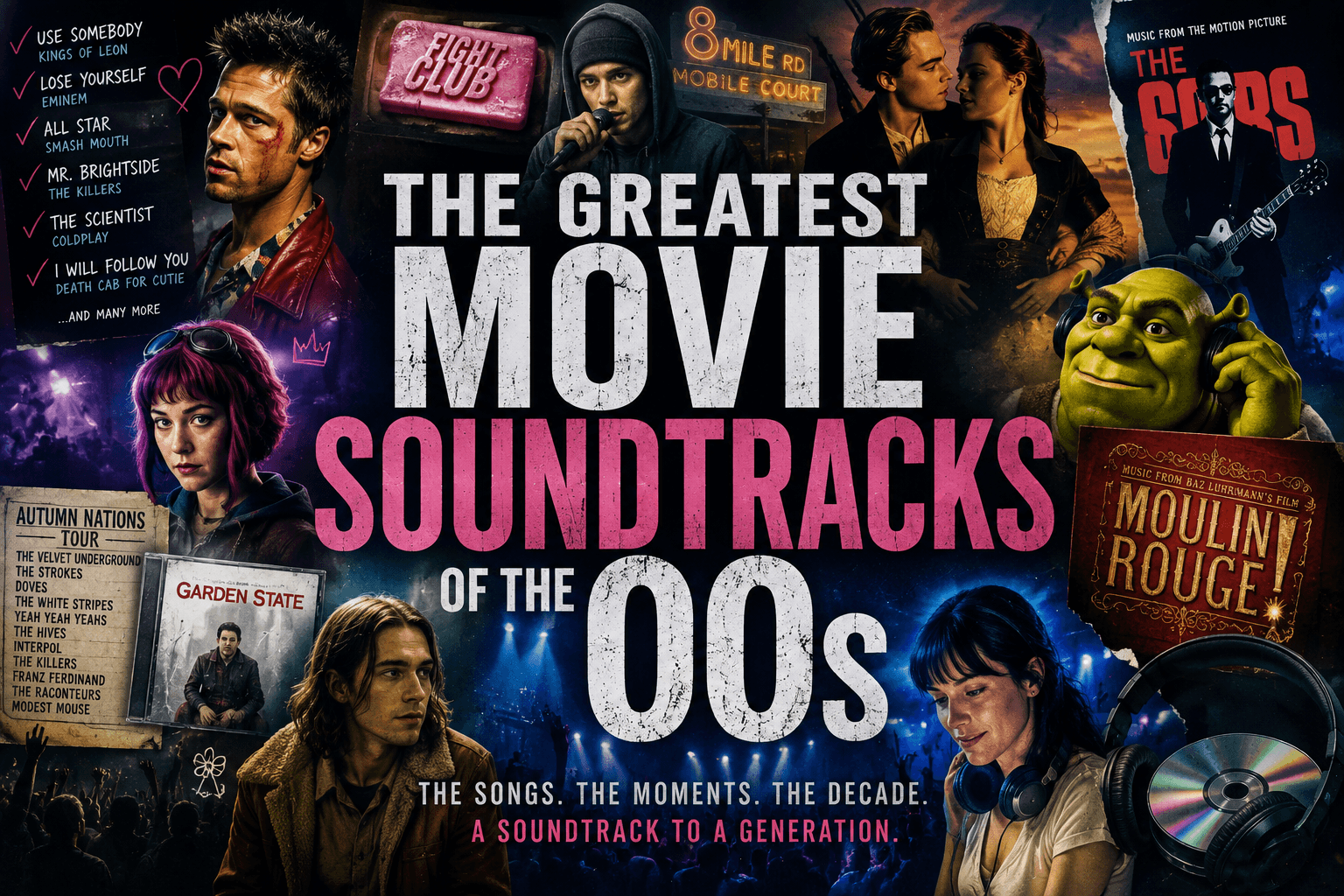
The Greatest Movie Soundtracks of the 00s
From mixtape culture to iPods, the 2000s gave movies songs that escaped the cinema and followed us everywhere.
PRESS PLAY
The 00s soundtrack lived beyond the movie
The 2000s arrived at a strange and brilliant moment for movie music. CDs were still everywhere, file sharing was changing how people found songs, the iPod turned up in 2001 and by the end of the decade carrying thousands of tracks in your pocket felt completely normal.
That made the movie soundtrack more than something you heard in the cinema. A film could introduce you to a song on Friday night and by Saturday you were trying to find it, download it, buy the album or stick it into a playlist that would outlive the movie itself.
The best 00s soundtracks understood that relationship. They did not simply decorate scenes. They gave films another identity you could take home with you.
ALMOST FAMOUS
Almost Famous made falling in love with music the whole point
Almost Famous is a film about music before it is a film with music. Cameron Crowe uses songs as part of William's education, connecting records to people, places and moments when he begins to understand the world he desperately wants to join.
The famous bus sequence built around Elton John's Tiny Dancer works because the song temporarily repairs a group that has started to fracture. Nobody needs to deliver a speech explaining that. They simply begin singing.
The soundtrack reaches backwards into the 1970s, but the way the film treats discovering music felt perfect for 2000: intensely personal, slightly obsessive and capable of making one song feel like a secret somebody handed directly to you.
MOULIN ROUGE!
Moulin Rouge! threw pop history into a blender
Baz Luhrmann's Moulin Rouge! behaves as though the entire history of popular music has been dumped into one enormous theatrical dressing-up box and everybody has been told to grab whatever fits.
Songs associated with completely different artists and eras are rearranged, combined and pushed through the film's heightened romantic world. The familiarity is part of the joke, but it also lets the movie reach emotion quickly because the audience already carries associations with much of the music.
It should be exhausting. Sometimes it absolutely is. But restraint was never the assignment. Moulin Rouge! made excess into a musical language of its own.
SHREK
Shrek turned pop songs into part of the punchline
Shrek's soundtrack is so tied to the film that hearing certain songs can now summon a green ogre before the original artist has finished the first line.
All Star had already been released before Shrek, but the movie helped weld it to a particular strain of early-00s pop culture. Then I'm a Believer arrives to turn the ending into a full celebration rather than a polite fairy-tale curtain call.
The music helped Shrek feel contemporary and irreverent at a time when its entire mission was to poke holes in traditional animated fairy tales. It sounded like the movie's attitude.
8 MILE
8 Mile gave us a song bigger than the film
Lose Yourself is one of those soundtrack songs that escaped immediately. You do not need to have watched 8 Mile recently for the opening guitar notes to trigger the film's world of pressure, performance and the terror of wasting your chance.
That connection matters because the song does not feel pasted onto the movie for the credits. It distils the same anxiety driving Jimmy Smith Jr.: the possibility that an opportunity can arrive once and disappear if you freeze when it matters.
Plenty of movie songs become hits. Fewer become motivational shorthand for an entire generation of gym playlists, sporting montages and people trying to psych themselves up before doing something unpleasant.
SCHOOL OF ROCK
School of Rock made the soundtrack part of the lesson
School of Rock could not treat music as background because music is the plot. Dewey Finn's entire worldview is built from records, bands, riffs and the sincere belief that rock can solve problems considerably more complicated than rock has any business solving.
Jack Black sells that belief because he never plays Dewey's enthusiasm as fake. The comedy comes from how completely committed he is. When he starts teaching the children about rock history, he behaves like civilisation itself depends on getting the syllabus right.
The soundtrack gives the film credibility without turning it into a lecture. It wants younger viewers to laugh, but it also genuinely wants them to go and discover more music afterwards.
GARDEN STATE
Garden State became a mixtape somebody handed you
Few 00s films are as closely associated with the idea of the carefully curated mixtape as Garden State. The music is not subtle about wanting to introduce itself to you, but that directness became part of the film's appeal.
The Shins, Coldplay, Zero 7 and others create a particular emotional atmosphere: melancholy without complete despair, introspection with enough warmth to keep moving. The soundtrack feels selected by a person rather than assembled by a committee.
That quality fitted the decade perfectly. This was the period when playlists increasingly became a way of presenting yourself to other people. Garden State practically hands the audience one ready-made.
MARIE ANTOINETTE
Marie Antoinette ignored period accuracy and found emotional accuracy
Sofia Coppola's Marie Antoinette could have filled Versailles with stately period music and behaved itself. Instead, the film reaches for post-punk, new wave and modern pop to make its young characters feel emotionally immediate.
The choice is deliberately anachronistic, but that is precisely why it works. The soundtrack is less interested in recreating what Marie Antoinette literally heard than in communicating youth, boredom, privilege, rebellion and the strange unreality of living inside a world built around spectacle.
It is one of the decade's clearest examples of soundtrack choices telling us how to feel a period rather than simply how to recognise it.
JUNO
Juno made small songs feel completely at home on the big screen
Juno's soundtrack has the handmade quality of the film around it. Kimya Dawson's songs are intimate, scruffy and conversational, which fits a story that would have felt completely different surrounded by polished pop anthems.
The music helps establish Juno's personality without pretending every lyric is literally describing her. It feels like the sort of music these characters might actually know, share and keep returning to.
By 2007, online discovery and portable digital libraries were making the distance between obscure and familiar much shorter. A successful indie film could suddenly send a huge audience looking for artists they had never heard before.
TWILIGHT
Twilight knew exactly what its audience wanted to hear
Whatever anybody thinks about Twilight as a film, its soundtrack understood the assignment. Paramore, Muse and the surrounding selection gave the movie a moody alternative-rock identity that matched its rain-soaked romance remarkably well.
Decode became particularly difficult to separate from the film's cultural moment. The soundtrack was not trying to appeal to everybody; it was helping define the emotional world for the audience already leaning towards it.
That specificity paid off. Twilight became one of the late decade's clearest examples of a soundtrack operating as both part of the movie and an extension of the fandom around it.
SLUMDOG MILLIONAIRE
Slumdog Millionaire ended the decade with a soundtrack that moved
A.R. Rahman's music is woven so tightly into Slumdog Millionaire's momentum that separating score from editing and movement almost misses the point. The film is constantly travelling, remembering, running and colliding with another piece of Jamal's life.
Jai Ho became the obvious breakout, but the broader soundtrack gives the film much of its pulse. It bridges different musical influences without treating that mixture as something requiring an explanation every five minutes.
By the end of the decade, a soundtrack from a film set in India could become part of a global awards-season phenomenon. That feels like a fitting place for the 00s to finish.
BEYOND THE SONGS
And the 00s had some enormous scores too
A decade of memorable soundtracks was also a decade of scores that became inseparable from their films. Howard Shore gave The Lord of the Rings an entire musical world. Hans Zimmer and James Newton Howard helped redefine the sound of Batman. John Williams gave Harry Potter's first cinematic adventures a theme recognisable within seconds.
Elsewhere, Clint Mansell's music for Requiem for a Dream travelled far beyond the film, while Dario Marianelli's Atonement score and A. R. Rahman's Slumdog Millionaire music showed how distinctive film scoring could be across the decade.
The methods were different, but the principle was the same as the best song-driven soundtracks: give the film a musical identity strong enough that hearing a few notes can bring the images back.
THE WAY WE LISTENED
The decade moved from soundtrack CDs to playlists in our pockets
Part of what makes 00s movie music distinctive is that the way we listened to it changed underneath the decade. At the beginning, buying the soundtrack CD still made perfect sense. By the end, individual tracks, downloads and playlists had transformed the relationship.
That meant a soundtrack no longer had to survive only as one physical album. A single song could break away from a movie, find its way onto millions of personal playlists and keep carrying a tiny piece of that film around for years.
The technology changed, but the basic magic did not. Hear the right song and suddenly the movie is back.
ONE MORE TRACK
The best 00s soundtracks gave the movies a second life
That is what connects the strongest soundtracks of the decade. They extend the film beyond the running time.
Tiny Dancer can put you back on the Stillwater bus. Lose Yourself can drag 8 Mile into the room before Eminem reaches the chorus. A Shins track can make Garden State feel five minutes away. The right piece of music does not merely remind you that you watched something; it restores some of the atmosphere around watching it.
The 2000s changed how we bought music, stored music and discovered music. Movie soundtracks came along for the ride — and some of them never really left our headphones.
Up next
More special features
More deep dives, arguments and trips back through 2000s cinema.
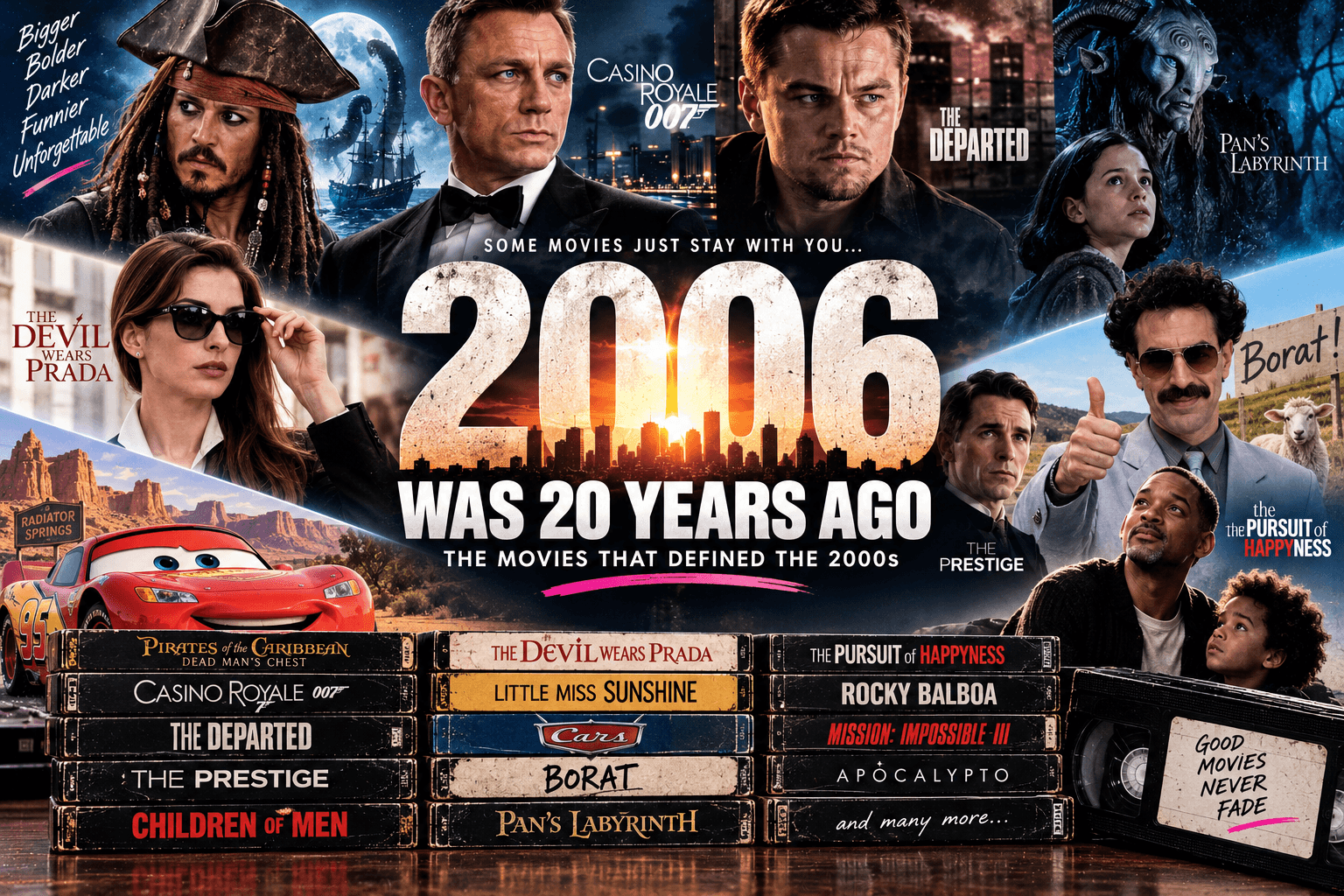
2006 Was 20 Years Ago — The Movies That Defined the 2000s
Casino Royale. The Departed. The Prestige. Pirates of the Caribbean. The Devil Wears Prada. Twenty years later, 2006 looks like one of the defining movie years of the 2000s.
Play feature →
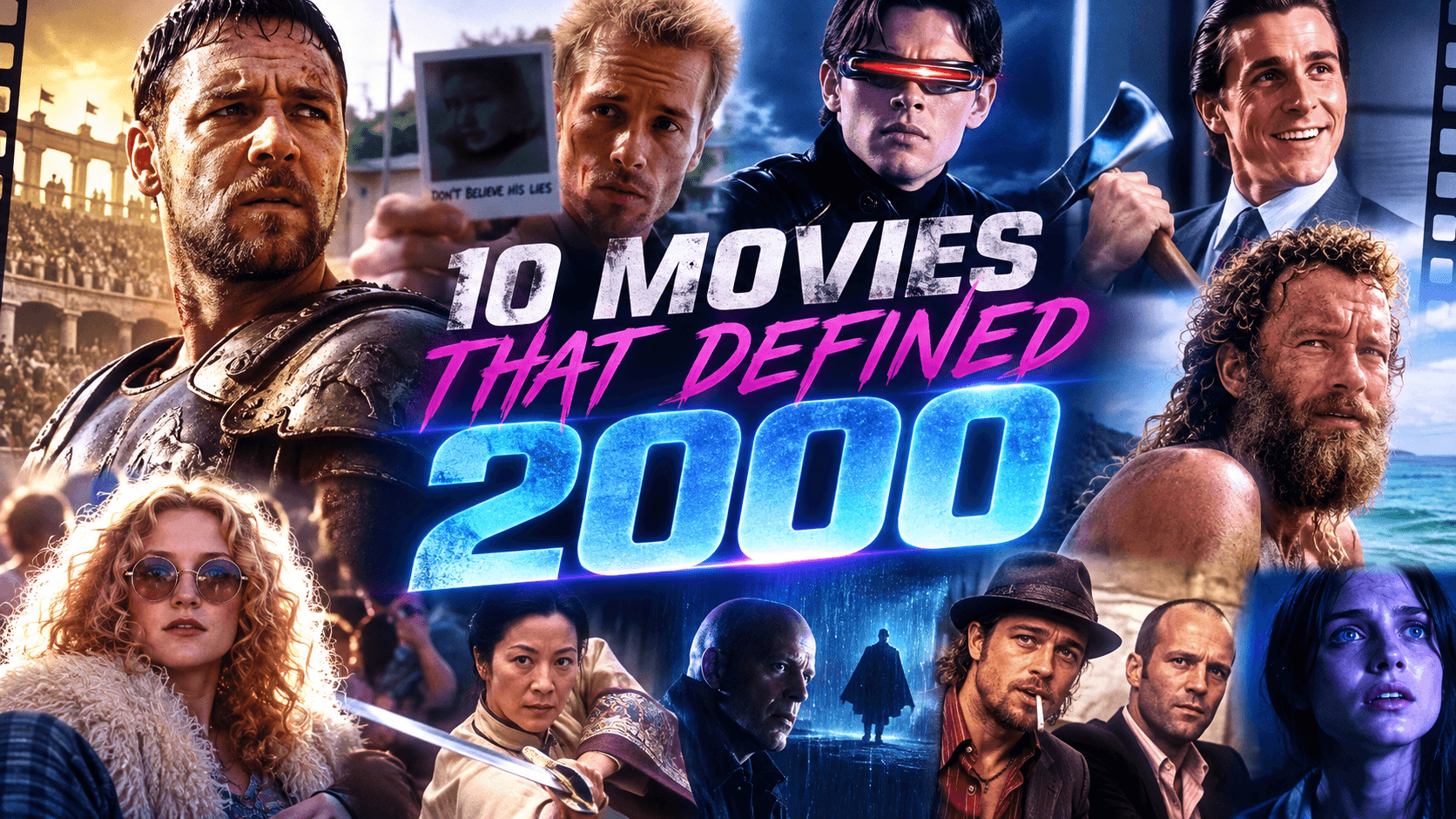
10 Movies That Defined 2000
The year that opened a new decade gave us Roman epics, fractured thrillers, superheroes, serial killers and some genuinely fearless filmmaking.
Play feature →