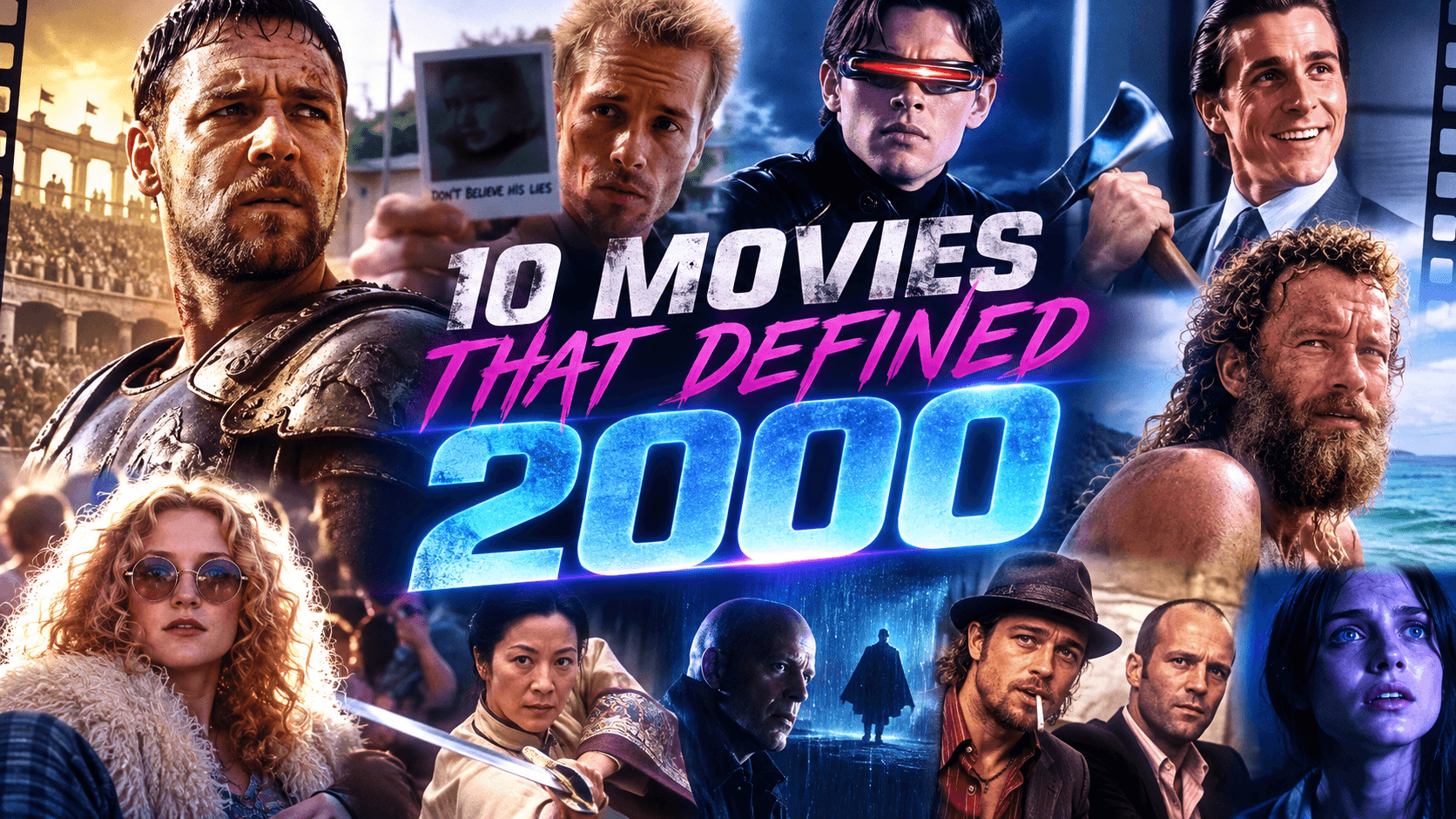
10 Movies That Defined 2000
The year that opened a new decade gave us Roman epics, fractured thrillers, superheroes, serial killers and some genuinely fearless filmmaking.
01
Gladiator made the old-fashioned epic feel enormous again
If one film announced that 2000 was going to be bigger than expected, it was Gladiator. Ridley Scott took the kind of historical epic Hollywood had largely stopped making and gave it enough scale, dirt, violence and emotion to make the genre feel immediate again.
Russell Crowe's Maximus became an instant movie hero: controlled until he needed not to be, furious without becoming cartoonish, and carrying a revenge story simple enough to survive all the political manoeuvring around it. Then there was Joaquin Phoenix's Commodus, turning insecurity into something poisonous every time he entered the room.
The film's influence went well beyond sandals and swords. Gladiator reminded studios that audiences would still turn up for a serious-looking spectacle if the characters gave them something to care about. The 2000s had barely begun and Hollywood was already thinking big again.
02
Memento turned a clever structure into the whole experience
Memento is the sort of film people describe by explaining how it works, but the trick is only half the reason it lasts. Christopher Nolan's fractured chronology puts us inside Leonard Shelby's uncertainty rather than simply telling us about his condition.
Scenes arrive with missing context. Motives shift as new information appears. Things we thought we understood become less comfortable a few minutes later. The structure makes the audience do some of the work, but it never feels like homework because the mystery keeps pulling you forward even while the story is moving backwards.
It also introduced a wider audience to a filmmaker who would spend much of the next decade proving that complicated ideas and mainstream entertainment did not have to live in separate cinemas.
03
X-Men helped convince Hollywood that superheroes could work
Before the superhero boom swallowed the multiplex, X-Men had to prove that a team of comic-book characters with names like Wolverine, Cyclops and Magneto could survive the jump to live action without becoming a joke.
The film is smaller than the superhero spectacles that followed, but that restraint now makes it fascinating. It spends time establishing the fear surrounding mutants, the ideological divide between Xavier and Magneto, and Wolverine's reluctant place inside a group he never asked to join.
Along with Blade before it and Spider-Man soon after, X-Men helped build the bridge to the comic-book dominated cinema of the 2000s and beyond. You can see the future of blockbuster filmmaking starting to take shape around it.
04
American Psycho found something horrifying underneath the perfect suit
American Psycho could easily have become a grim endurance test. Instead, Mary Harron's film understands how absurd Patrick Bateman's world is and lets that absurdity become part of the horror.
Christian Bale plays Bateman with terrifying commitment and just enough comic precision to make conversations about business cards, restaurant reservations and pop music feel as revealing as the violence. His polished surface is so aggressively maintained that the cracks become impossible to ignore.
The result became one of those films whose cultural life kept expanding long after release. Bateman escaped the movie and became an endlessly quoted, imitated and misunderstood figure, which is perhaps fitting for a story so interested in surfaces swallowing the person underneath.
05
Almost Famous looked backwards without feeling trapped there
Cameron Crowe's Almost Famous is set in the 1970s, but it arrived in 2000 with a very particular kind of affection for music, fandom and the moment when loving something begins to collide with understanding how the business around it actually works.
William Miller's trip with Stillwater is funny, exciting and occasionally ridiculous, but the film never loses sight of the loneliness underneath all that supposed freedom. Everyone wants to be close to the music, and almost everyone is pretending to be slightly more certain than they really are.
It is also a reminder that nostalgia works best when it contains some friction. Almost Famous loves its world without pretending everybody in it behaved beautifully. That makes the affection feel earned rather than manufactured.
06
Cast Away proved a blockbuster could become almost completely quiet
Tom Hanks spends a huge stretch of Cast Away with nobody to talk to except a volleyball, and somehow the film never feels as though it has run out of things to say.
Robert Zemeckis strips away the normal machinery of a studio drama and lets survival become physical. Fire matters. Water matters. A cut hand matters. Time passes across Hanks' body rather than through a convenient montage telling us everything is fine now.
Wilson becoming emotionally important should be ridiculous. Instead, by the time that relationship reaches its most famous moment, the film has done enough work to make a painted volleyball feel like company. That is a fairly astonishing trick.
08
Snatch arrived talking at a hundred miles an hour
Snatch is not interested in easing you into its world. Guy Ritchie throws gangsters, gamblers, bare-knuckle boxing, stolen diamonds and several competing disasters into the same machine and then seems delighted when the gears start flying off.
The editing is restless, the dialogue is endlessly quotable and the cast behaves as though every character is starring in a slightly different crime movie. Brad Pitt's Mickey, in particular, walks away with enormous chunks of the film while making half his dialogue deliberately difficult to understand.
Its style became heavily imitated, which can make it easy to forget how fresh that energy felt around 2000. Snatch is messy by design, and that mess is a large part of the fun.
09
Unbreakable treated superheroes like a secret nobody had noticed yet
Years before superhero cinema became the default setting for Hollywood, Unbreakable approached comic-book mythology almost in a whisper.
Bruce Willis' David Dunn does not wake up eager to become a costumed hero. He slowly confronts the possibility that something about him is different, while Samuel L. Jackson's Elijah Price has spent a lifetime searching for meaning in his own fragility.
M. Night Shyamalan treats comic-book ideas with complete seriousness without sanding away their strangeness. Seen from the other side of the superhero explosion, Unbreakable now feels even more unusual: a superhero origin story that barely looks like one until you realise it has been there all along.
10
Requiem for a Dream made addiction feel impossible to escape
Nobody puts on Requiem for a Dream because they fancy a relaxing evening. Darren Aronofsky builds the film around repetition, acceleration and obsession until the style itself begins to feel compulsive.
The tragedy is spread across different kinds of addiction and different kinds of hope. Each character believes there is still a version of life waiting just beyond the next decision, and the film keeps narrowing those possibilities until almost nothing is left.
It is punishing, deliberately so, but difficult to forget. That willingness to be formally aggressive and emotionally unpleasant is another reason 2000 feels like such an interesting starting point for the decade. Cinema was not exactly playing safe.
THE YEAR
2000 didn't feel like a warm-up
Looking back, what stands out about 2000 is the range. A Roman epic could dominate the conversation while a backwards thriller became a word-of-mouth obsession. Superheroes were testing the water, international cinema was crossing over, crime films were getting louder and filmmakers were still finding room for genuinely strange choices.
Not every trend of the next ten years begins here, and no single year can explain an entire decade. But 2000 already contains plenty of the tensions that would shape what followed: spectacle versus intimacy, franchises versus originals, digital change versus old-school filmmaking, and an audience becoming increasingly comfortable moving between all of them.
For Movies in the 00s, there could hardly be a better place to press play.
Up next
More special features
More deep dives, arguments and trips back through 2000s cinema.
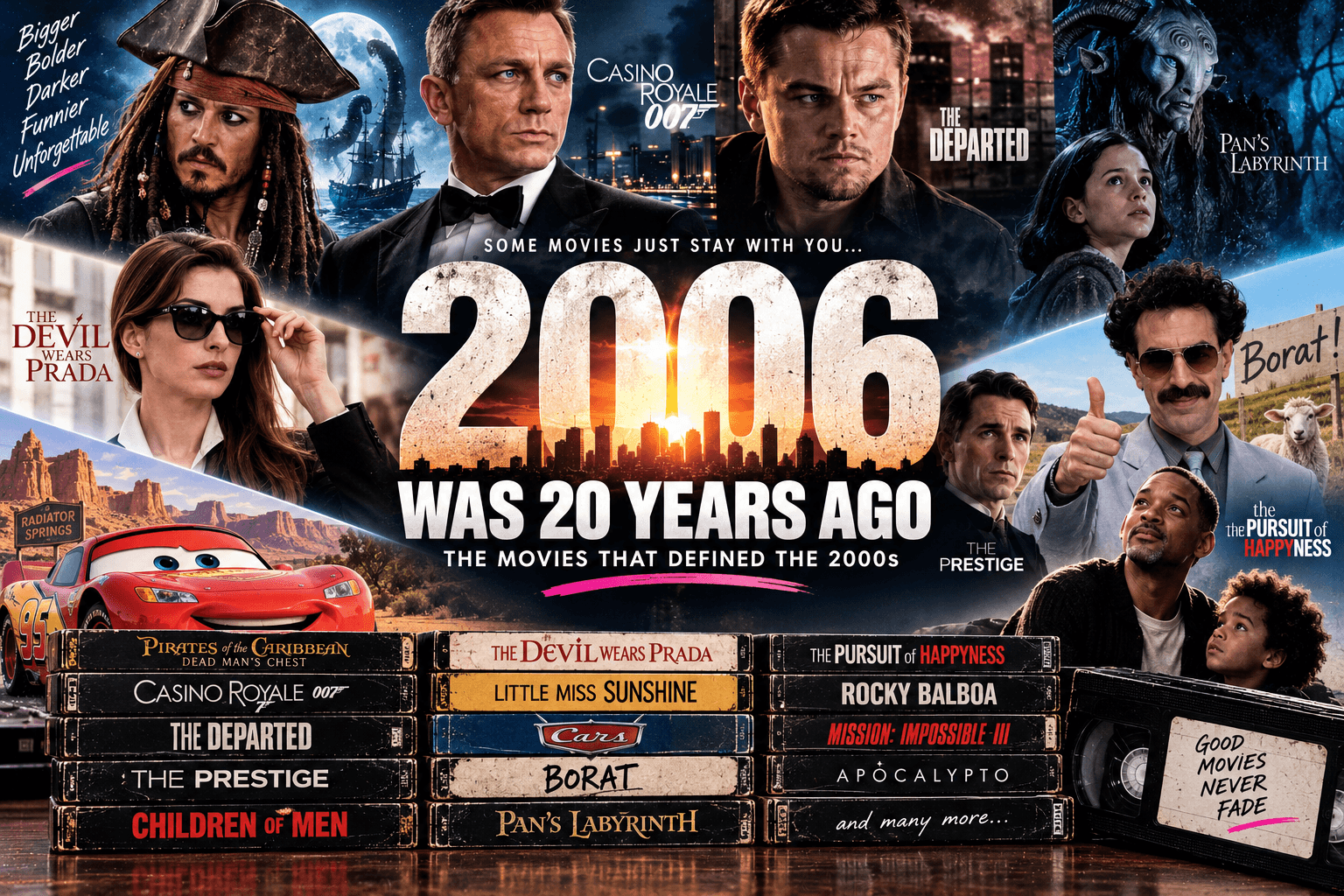
2006 Was 20 Years Ago — The Movies That Defined the 2000s
Casino Royale. The Departed. The Prestige. Pirates of the Caribbean. The Devil Wears Prada. Twenty years later, 2006 looks like one of the defining movie years of the 2000s.
Play feature →
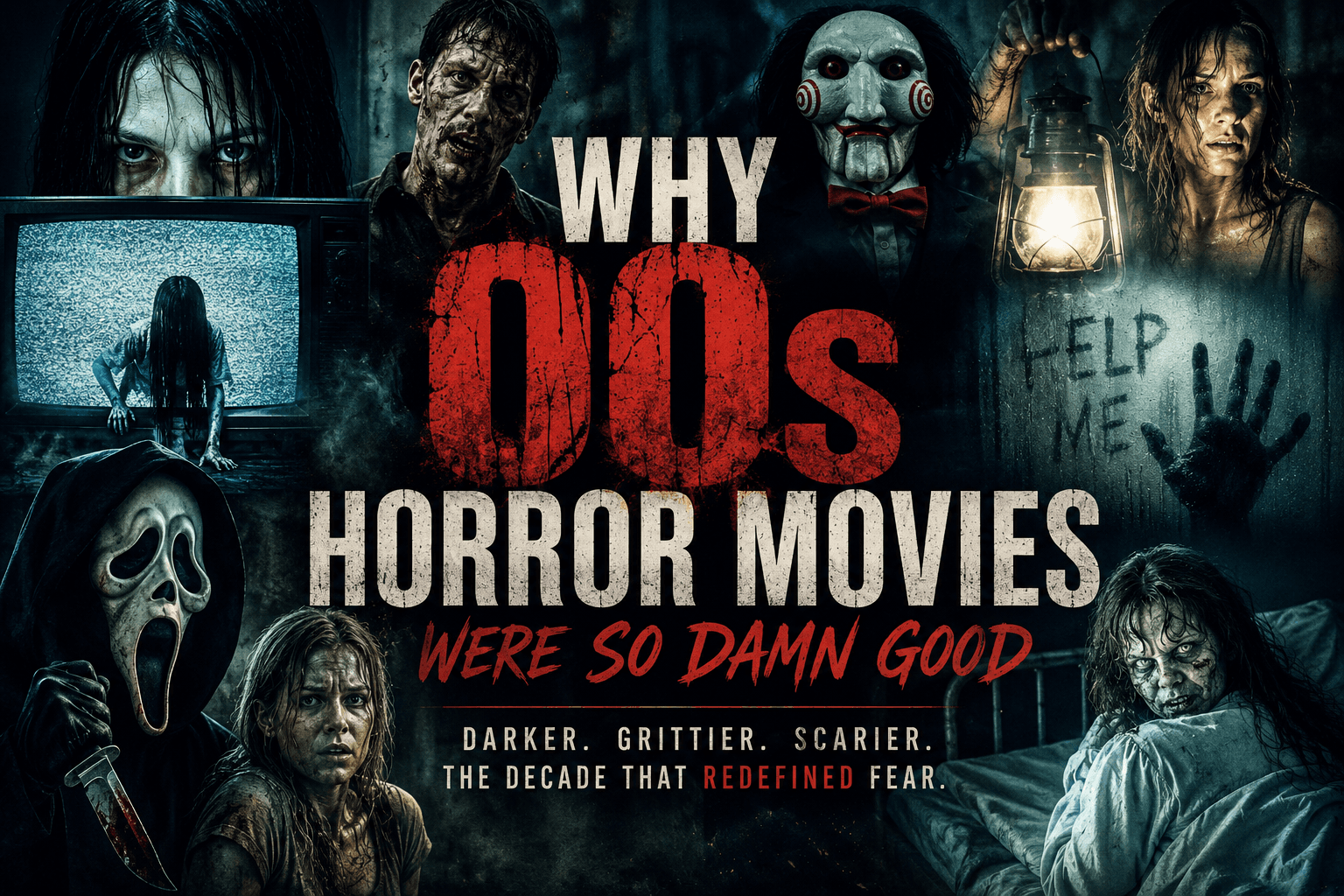
Why 00s Horror Movies Were So Damn Good
Zombies ran, ghosts crossed oceans, traps got nastier and horror stopped obeying one set of rules. The 2000s were gloriously all over the place.
Play feature →